KPOP Jacket Lady
KDrama and KPOP Concert Reviews, Travel Tips, Korean Recipes and more
BIGBANG10 THE EXHIBITION A TO Z
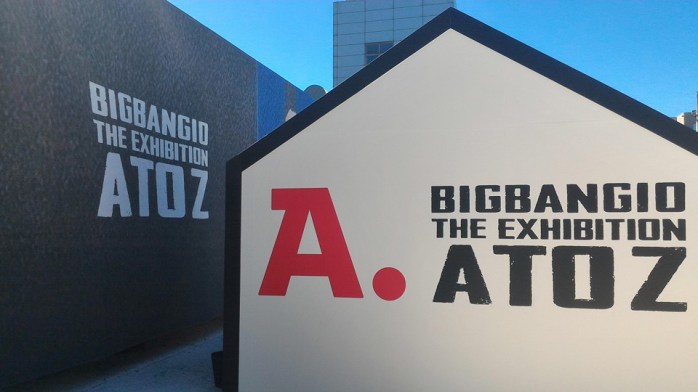
With BigBang being my favorite group it was obvious we would find their exhibition early in our trip. Not knowing how popular it would be I asked a Korean friend to get tickets for us, but surprisingly it wasn’t too crowded and tickets were still available at the ticket booth. The exhibition was held at S Factory an up and coming event space in Seongdong, a couple of blocks from Seongsu subway station. It is in a slightly seedy part of Seoul that is gradually being turned into a haven for artists.
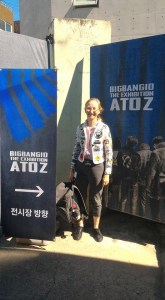
We arrived just before the doors opened and there were about 20 people waiting, so not too busy for our look into the past 10 years of BigBang. The rooms had general themes, as well as areas showcasing the past, present, and future. The 5 members all helped to both curate the exhibition and produce their own pieces of art.
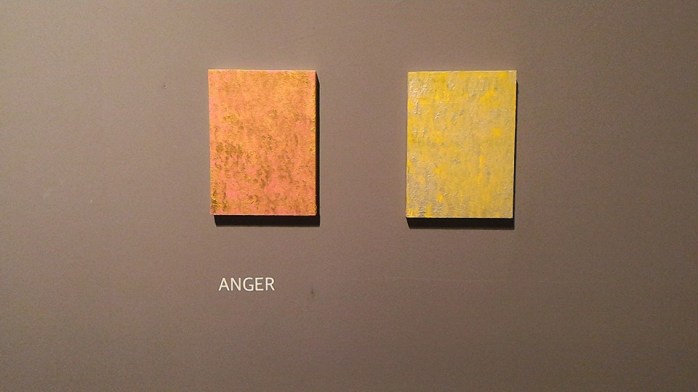
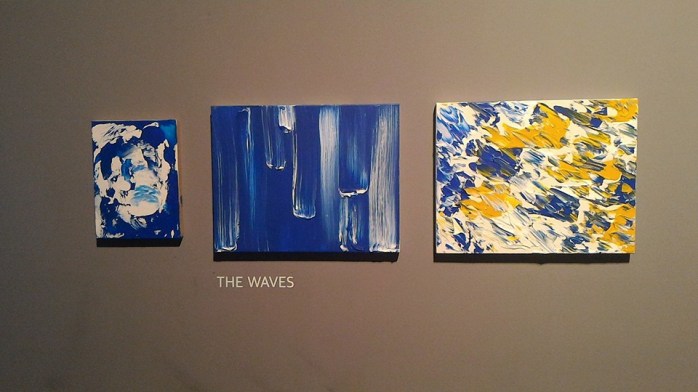
I was impressed with their artwork, although I would have loved to know who produced which pieces.
The exhibition space was full of BigBang in more ways than just the art on the walls or the music piped into each room. I could feel some of their character and individual color, it was a little like being inside their minds and hearts. You could feel the love they have for their fans in many subtle and perhaps unintentional ways. The most profound art pieces for me were their individual portraits, which were quite striking.


Although you can’t see from the photos the art contained some stitches/sewing for some of the ‘graffiti’ on Seungri and GD, adding some depth and texture that does not show up well in these photos.
There were multiple rooms with the first room having graffiti and messages from fans. Other rooms had posters of BigBang, there were media rooms with videos playing, a room where you could listen to their playlists and everywhere there were touches of them shinning through.


It is hard to capture the real feel of the exhibits, but it was very worthwhile experience for all BigBang fans. Some areas didn’t have as much background information as I was hoping for, but it definitely was a striking and interesting look into the last ten years of BigBang.

GD said in an interview that the BigBang Tree was his favorite as it was a reminder of so much of his past. The tree was filled with clothes, and shoes, and parts of their stage outfits. Unfortunately it was positioned in such a way that you couldn’t get a really good look at it, even with the mirrored wall. The lights made reflections so it was hard to identify individual pieces of clothing.
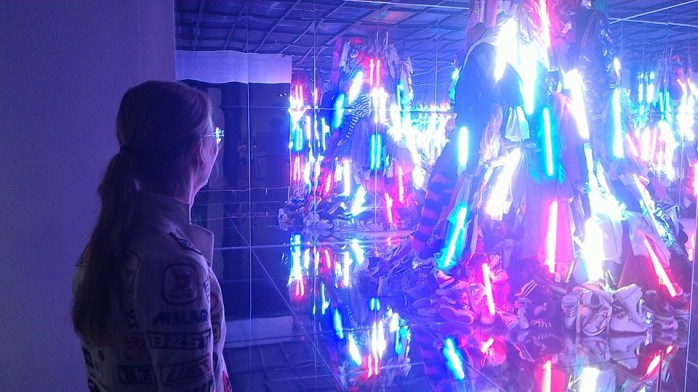
The exhibition continues until the end of October and is definitely worth a visit, particularly if you combine it with a visit to nearby Seoul Forest, or Gangnam which is just across the river.

We made a quick visit to the gift shop where they have some goods unique to the exhibition available, but didn’t indulge. We did, however, get a couple of cheap giveaways for visiting which was kinda nice.
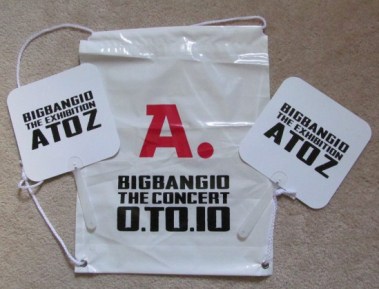
Have a great day everyone.
You may also enjoy A Walk Down KStar Rd, KBS Studio Tour, and A Visit to SUM Market.
Photo credits to Elle Marzec. Do not copy, or use, without consent and accreditation.
A few highlights from my recent Korea trip.


There’s so much to like about a visit to Korea that it is hard to choose only a few photos to give you the ‘quick look’ as it were. Needless to say I’ll be writing quite a few posts in the upcoming weeks. I got home this morning so with unpacking and jetlag, there’ll be more photos than descriptions. Keep checking back for stories of our adventures in Seoul, Busan, and Jeju Island.


There are so many amazing buildings and street art everywhere you look…


both traditional and modern.


The food is amazing, from street carts, to restaurants, to food night-markets, the variety of things to try is incredible.


From Kpop to street performers, music was everywhere.


Korea is an incredibly beautiful country.


It has every kind of street market.
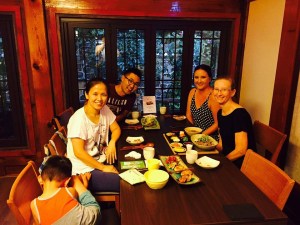
The best things about the last trip were sharing food with our friends, and specifically for me it was spending time with my daughter.


Have a great day everyone.
Photo credits to me and Elle Marzec. Please do not use without crediting owner.
Like Dance? Watch Kpop, Part 2.

I part one I discussed the choreographers behind BTS’s Fire, (Keone Madrid) SHINee’s Lucifer, (Rino Nakasone & Shim Jae Won) and Big Bang’s Bang, Bang, Bang, (Parris Goebel) pointing out the importance of choreography to the visual impact of the group in MV’s, performances, and concerts. The point of these posts is to highlight the people behind the dances, while still acknowledging that even the best choreographer has to work within the capabilities of the dancers, and not to determine the ‘best’ as that is such a subjective qualification that often leaves people disappointed and upset.
Kpop is oozing with talent on multiple levels, however, to rise to the top and have a hit song many things must come together and the talents of the group members are just one part of a larger whole. Musical, dance and vocal ability, as well as appearance are all important, but so are the composers, the writers, the producers, the stylists, the publicists, and of course having the financial backing of an entertainment company. I have noticed that many people who contribute to the overall success are given credit on sites such as Youtube, or even agency websites, but very rarely do you see the choreographers prominently credited. I would like to see this change and hope, in a small way, to make people think about the people who came up with the dances we love. I know that even with no music many dances are so iconic that you immediately know which song they are from, which says alot about the importance of the dance to the song.
Good choreographers produce dances that enhance the visual experience and that also highlight emotions, all while keeping everyone moving in tune with the beat and the music. They create new moves and ‘tricks’, work out placement, and most importantly do this while taking into account the skill level of all the group members.
When BAP debuted in 2012 with Warrior they immediately grabbed my attention. They were completely different from the rest of the groups I was familiar with and their choreography was different too. Created by veteran choreographer Park Sang Hyun (sometimes Hyeon) the dance was powerful and intense, with elements of hip-hop, krump, and step. The fierce, aggressive dance style tied in perfectly with the fast, strong beat of the music. Even today I think it holds up well against newer groups and would like to see BAP return to the ‘dark side’ instead of producing upbeat summer type songs like That’s My Jam. I saw BAP in concert back in 2014 and still think it was one of the better concerts I’ve ever attended. Park Sang Hyun is a choreographer with TS Entertainment, and has choreographed songs for Secret, as well as for Hyosung.
Growl, choreographed for EXO by Nick Bass deserves recognition on multiple levels, but just speaking for the dance part Nick had many challenges to overcome. First he had a large group of people to choreograph for, and they had to tell a story which had to continue on from the story in Wolf. He also had to make up for that rather odd and lackluster song by creating something with visual appeal that held everyone’s interest. He had a large space to fill with a dance that was going to be shot in one take, something almost unheard of in Kpop. The dance had to utilize all the members and would also have to be capable of being adapted for the stage. A SM Entertainment Performance Director was on hand to assist and apparently there was input from SM idols as well. EXO did a marvelous job, not just with the choreography, but with dealing with dancing in the round and having to always know the position of the camera. Nick Bass is a well known American dancer and choreographer and has worked with such stars as Usher, Janet Jackson, and Justin Timberlake. His style has a fluid grace and yet there is a power and intensity there too. I look forward to seeing his future work.

Last week I was catching up on some Weekly Idol episodes and caught episode 261 which towards the end has the guest idol groups perform one of their songs at double speed, which is quite funny to watch. When BTOB danced to WoW it was both amusing and chaotic, and it reminded me of how much I used to enjoy the choreography of some of BTOB’s songs. I tried to find out who the choreographer was for WoW, but with no success which just proves my earlier statement that often choreographers don’t get the credit they deserve.
I’ve had a similar experience in trying to find the choreographer behind BLACKPINK’s songs Whistle and Boombayah. The MV for Whistle has very little in the way of choreography, although there is more if you watch their stage performances or dance practice videos. Boombayah is a different story as I found the choreography a nice change from a lot of the Kpop girl groups overt sexuality or cutesy, cloying sweetness. At least BLACKPINK seemed to be enjoying dancing and showing off a bit of sass and attitude. Their dance practice video also shows off the choreography fairly well. But who choreographed the dances? Scuttlebut suggests that YG asked 4 famous foreign choreographers to submit ideas, and then he chose the moves he liked best from each and put them all together. Two of the choreographers that I’ve heard mentioned are Jonte and Kyle Hanagami, but I don’t know who the others might be. (Parris Goebel did the choreo for the pre debut dance, but says she didn’t work on Whistle or Boombayah.) So it sounds as if the songs were choreographed long distance in a loose sort of collaboration of choreographers who didn’t work on it together and then YG put the bits he wanted together. Sounds strange, although YG has actually been credited with being the choreographer for 2NE1’s Come Back Home, so maybe he knows more than it would at first seem. I did enjoy the choreography for Boombayah, but like many people, felt the shadow of 2NE1, and the overall YG-ness of the BLACKPINK ‘packaging’.
As you’ve probably noticed I like an eclectic and broad group of Kpop music and dance, and I do have favorites. However sometimes I like, or dislike, a particular song just on a feeling, which in a way is good for the Kpop industry, because if we all had the same musical taste think how boring the genre would become. We each have our own ideas on what we think is good or bad and I respect that, so if there is a particular choreographer’s work you would like me to cover in a future post, or if you disagree with my choices please feel free to share in the comments section below. If you know more about any of the choreographers I would love to hear from you.
Have a great day everyone.
Photo credits to original owners. Probably TS Entertainment for BAP… SM Entertainment for EXO… Cube Entertainment for BTOB… and YG Entertainment for BLACKPINK.
Like Dance? Watch Kpop.
Those who already watch Kpop know just how much amazing choreography is showcased by the whole genre, but for those who haven’t thought much past the derisive image that the term ‘boy group’ or ‘girl group’ conjures up, you’re in for a pleasant surprise. Not only are many routines choreographed by some of the best choreographers in the world, think Parris Goebel, Keone Madrid, or Nappytabs, but the groups that perform these routines contain some outstanding dancers. In fact there are so many to choose from I would have to write multiple posts to be able to cover them all.
The dance that springs to mind first for most people when Kpop is mentioned is probably the ‘horse riding dance’ from Psy’s megahit, Gangnam Style which is in the billions of views on Youtube. It was created by Lee Ju Sun who says he was paid ‘a miniscule amount’ for the choreography. He goes on to say that later he did receive a bonus from Psy, but I’m not sure if he feels it was fair considering that the dance had such a large part of making the MV a worldwide sensation. He also choreographed Gentleman and is now trying to become a singer himself.
Dance choreography does fall under copyright laws and the creators should receive credit and compensation, but these laws vary in rigor and enforcement from country to country. Well established names in the business tend to do ok, but young up and comers have a harder time being paid a fair amount for their work. This situation has seen some improvement in the world of Kpop since the early years, and shows such as Hit the Stage that are focusing on the importance of dance in the Kpop world should help even more.
Dance is an integral part of any Kpop MV or performance and many groups can be recognised by their iconic dance moves. Their popular moves often have names and occasionally fans are asked to provide those names for them. Dance practice videos which showcase the choreography without the distractions of sets, props, and elaborate costumes are becoming increasingly popular on Youtube with some reaching into the millions of views.
Even a first run through list would contain well over 25 choreographers so for today I’ll mention some of my favorite dances and speak a little about the choreographer for each.

Right now I’m still enjoying Fire by BTS, with the choreography by Keone Madrid. What is truly amazing is that BTS learnt this routine by video! Which leads me to the point that in many cases there is an overall choreographer credited, but that doesn’t mean that assistants, group members, and dancers don’t often have input into the overall finished product. Just like Kpop rappers are known for collaborating on their lyrics so do the dancers in the group have ideas so what will work for their particular group. Keone is an American working out of San Diego. CA. where he lives and works with his wife, Madrid, another well known dancer and choreographer. Together they have appeared on So You Think You Can Dance and have their own Youtube channel, which lists some of the other Kpop choreography they’ve worked on including Taeyang’s Just a Feeling, 2PM’s My House, Got7’s Just Right and A, and many more. I think Keone has a very watchable style, somehow smooth and lyrical and yet with plenty of hard hitting fast moves that pack a visual punch. In the future I hope to see him actually in Korea working with BTS and other Kpop groups.
I was at one of the Fly In the USA concerts for SHINee recently and it reminded me of how great some of their dances are. One of my favorites is Lucifer, choreographed by Rino Nakasone and Shim Jae Won. Large entertainment groups like SM Entertainment often have access to a larger pool of choreographers than some of the smaller agencies, and more collaborations happen by pairing an in house choreographer with an outside talent brought in for a particular song. In this case Shim Jae Won works at SM and Rino is from Japan. They have also worked together on the TVXQ song Keep Your Head Down, a fairly well choreographed piece if you can get past the costumes. Rino first worked for SM back in 2008 on SHINee’s debut song Replay, and has choreographed pieces for BoA and Girl’s Generation among others. Shim Jae Won has worked with SM groups for years and knows their strengths and weaknesses allowing him to create dances that showcase their talents.
BigBang is known for many things, but they’re not usually at the top of anyone’s list of best dancing groups, although Taeyang is individually recognised as being one of Kpop’s most talented dancers. But that doesn’t mean that they don’t have some good choreography and dances, because they do. As noted above, a good choreographer knows how to showcase the talents of each member and how to tie those talents into the song and the music. YG Entertainment has their own talented choreographer in Lee Jae Wook, but they are quick to use outside talent, such as Aimee Lee Lucas, Shaun Evaristo, and Parris Goebel.
I enjoyed Bang, Bang, Bang, choreographed by Parris Goebel, who along with her different crews, has won a total of 16 medals at the World Hip Hop Dance Championships. Her choreography is innovative and visually interesting with moves that while looking easy are not. Her interpretation of the music is spot on too. She calls her style polyswagg and says it is based on “hearing, breathing, and living the music.” Parris also worked with Taeyang on Ringa Linga a song which received much praise from within the global Hip Hop community. She has worked with other artists from YG and has said she is looking forward to future collaborations. She is perhaps best known for her work with Justin Bieber, with her collaborations with him having reached over 3 billion views on Youtube. Parris is from New Zealand, of Samoan descent, and has worked all over the world. I look forward to her sharing her skills, and style, with more YG artists. She has an amazing talent.
I would like to finish up today by stating the obvious, that while Kpop groups are carrying out their amazing and complex choreography they are also singing. I have seen enough groups live to know that lip syncing on stage hardly, if ever, happens nowadays. (MV’s are another story.) So kudos to those idols who perform smoothly such challenging and intricate choreography and a very special thank you to the often overlooked people who created it. My hope for the future is that more people will appreciate your contributions and that you have every success in the future.
Who is your favorite choreographer, or what is your favorite Kpop dance? Let me know in the comments below, thanks.
Have a great day everyone.
Photo credit goes to original owner. Probably SM Entertainment for EXO and SHINee, YG Entertainment for Psy and Big Bang, TOP Media for Teen Top, and Big Hit Entertainment for BTS.
Kai Bai Bo: aka Rock, Paper, Scissors.

As anyone who has watched Korean TV Variety Shows can tell you certain games show up time and time again. One of these, kai-bai-bo, literally scissors, paper, rock, is extremely popular as a ‘choosing’ or ‘starting’ game, meaning it is what you play to make a decision such as which team will start the real game, or who pays the bar tab. Choosing games using just hands have a long history, but being so simple and requiring no equipment means it is often hard to track down their origin. Considering there are tomb paintings from Ancient Egypt showing some types of hand games, as well as accounts from Ancient Greece and Rome it appears that the 16th century Chinese author of Wazazu‘s claim of rock, scissors, fabric being played in the later part of the Han Dynasty (200 BCE – 200 CE) are believable. So it seems that at least 2,000 years ago people in many cultures were playing hand or fist games. In some parts of China today rock, paper, scissors is still called ‘guess my fist’.
Were all these games rock, paper, scissors? No, but they fall into the same general family of games, which also includes slapping and clapping games. The Romans played micato, (micare digitis in Latin which is literally “to flash with fingers”) which is similar to the modern game of morra, where each player shows their hand with a number of fingers extended as each player shouts out what they think the total number of all fingers shown will be. The winner being the person who guesses correctly. There are multiple variants of this type of hand game to include odds & evens and ones & twos.
The first definitive reference to rock, paper, scissors comes from around the year 1600 CE in China, and until someone can prove otherwise I think it is fair to assume this specific type game originated there, despite internet claims to the contrary. At this time China was trading throughout Asia and it is easy to believe the game spread in that way. I can’t find any mentions of it showing up in Korea at this point in time, but there are references to it and similar games showing up in 17th century Japan having come from China.
,_Japanese_rock-paper-scissors_variant,_from_the_Kensarae_sumai_zue_(1809).jpg/300px-Mushi-ken_(%E8%99%AB%E6%8B%B3),_Japanese_rock-paper-scissors_variant,_from_the_Kensarae_sumai_zue_(1809).jpg)
In Japan these games were grouped under the ken family, or sansukumi-ken ‘the three who are afraid of each other’. Mushi-ken is said to be the oldest variant to come from China, and it uses the thumb for the frog, the little finger for the slug, and the index finger for the snake. If you’re wondering why a snake is afraid of a slug, that is probably due to a translation/language error as in China it was originally a frog, a snake, and a poisonous centipede who could climb into the snake’s head and poison it. In Indonesia this is man, elephant, ant, where the ant either climbs the elephant’s trunk and tickles him to death, or enters his brain and drives the poor elephant crazy. A popular Japanese variant was kitsune-ken, which is unique because it used gestures needing both hands. The ones who were afraid of each other were a fox, a village headman, and a hunter. It has been said that when these games came to Japan from China that they were drinking games, and also sometimes played like strip poker in the local brothels. There is a handbook of Japanese ken games from 1809.
The version that turned into the game we play today was janken, which is still extremely popular in Japan today. It is played by adults and children alike and has become a part of popular culture. The Jpop group AKB48 has even used a janken tournament in order to determine which members would appear on their next single. And in 2005 when a rich businessman couldn’t decide which famous auction house would sell his extensive art collection he made them play janken!
There is some debate if kai-bai-bo arrived in Korea from China at an earlier date or if it arrived with Japanese occupation. It does seem likely that it was the latter as anthropologist Stewart Culin in his 1895 book, Korean Games, with notes on the corresponding games of China and Japan, does not mention a rock, paper, scissors, type game for Korea, although he does list a couple of hand games. He does describe, however, the ken games of Japan.
Rock, paper, scissors, sometimes called Rochambeau or roshambo in the West, starts to show up in Europe in the mid 1800’s but it is not until the 1930’s that there’s a written reference to the game in the USA. This is not to say immigrants weren’t playing the game before then, but that it wasn’t sufficiently mainstream to be a part of general culture. The huge rise of the popularity of rock, paper, scissors around the world came in the post WWII years and has continued with the spread of globalization. Anime, Korean Variety Shows, online games, and other entertainment sources have elevated it back into the consciousness of many who remember playing it as children.
Rock, paper, scissors has been described as the “purest form of competition two minds can have with each other” and is actually a fairly sophisticated game that uses psychology and principles of game theory. There are only three possible outcomes and a tie. And although the game itself is random, the humans who play it are not and good players can soon take advantage of that. Many pro players in fact use predetermined gambits and the people they hate to play the most are children, because they in fact come closest to being random players. Much time has been spent studying the game and some people claim to have winning strategies, but so far the only 100% winner is a robot who cheats. He has a camera so fast it detects the beginnings of his opponent’s hand movements and then throws out his hand.

There are quite a few different versions of kai-bai-bo played in Korea, with an upgraded version called muk-jji-ppa being quite popular. Other versions work better in multiplayer situations and can mess with the minds of a more traditional player. So next time you’re in Korea and it is time to decide who is going to pay for something make sure your kai-bai-bo skills are up to form and good luck.
If you have any more information or would like to comment please do so below.
Other game posts you might enjoy are alkkeggi, gonggi, jegi chagi, yut, tuho, ddakji spinning tops, rope swinging, and ssireum.
Have a great day everyone.
All images belong to original owners. 1st Image SBS. 2nd in public domain. 3rd from Favim.com/image/2686559/ Please do not copy without permission and accreditation.
Hotteok.
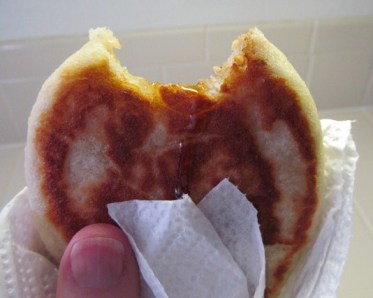
Walking the streets of Insadong last Spring we came across a grouping of street vendors selling a wide selection of different foods. The smells were intense and intriguing in the cold morning air, with the sweet smell of warm sugar and cinnamon subtly enticing us to the stall with the longest line. The line was made up of mostly Koreans, not tourists, which usually means the vendor has a good local reputation. While I joined the line, my daughter checked out the other stalls and bought a few things to nibble on while we waited. The line we were in was for a stall selling only one thing, Hotteok, a slightly sweet cross between a pancake and a doughnut that is filled with a gooey filling of brown sugar, cinnamon, nuts, and little bits of other things according to each stalls’ home recipe. It was served hot, sandwiched between a folded 3″x 5″ index card. You had to be careful biting into it as the insides were potentially molten, but watching others eat, we saw that you want to eat it as soon as it is possible to do so. That the goal is to eat it while the insides are still runny and hot and that it oozes out as you bite into it. It is probably my favorite street food.
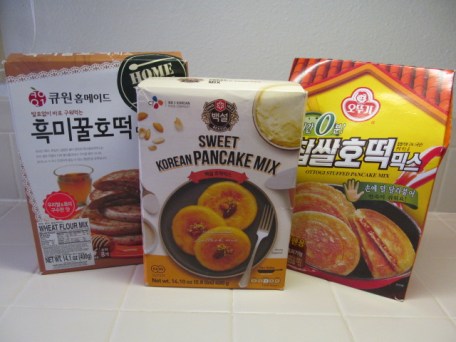
I’ve made Hotteok a few times since I’ve been home, both from scratch and prepackaged mixes, and while I’ve come close I still haven’t quite made any as good as the ones I had in Korea. There are quite a few recipes online and while I’ve tried some, I obviously haven’t tried them all. Instead I’ve been experimenting on my own to see if I can recreate something close to what I tried. If you look at the recipes you will see suggestions for which type of flour to use, whether to use milk or water, or even if you should use an egg in the batter. I admit mine isn’t quite right yet, but it makes a tasty batch of Hotteok and they all disappeared off the plate as soon as I had finished taking photos. The recipe below is for a relatively small batch, makes about 6, and takes a little advance planning as it is a yeast recipe and so needs to rest.


The ingredients are fairly basic, and I use a mix of white all purpose flour and rice flour, because white flour is cheaper and easier to have on hand, and rice flour because it helps add the stickiness you need in the dough to hold the ingredients in. If you look at other recipes you can find some use all one kind, some the other, and yet others a mix of both. Rice flour is getting much easier to find in your local supermarket, although often with not many choices.
Sieve white and rice flour totalling 1 1/4 cups into large bowl. This time I used 1/2 cup white flour and 3/4 cup of the rice flour. Add 1/2 tsp salt and 1 tsp white sugar. You need the salt and sugar to feed the yeast. I used 1 tsp instant yeast, because you can just add instant yeast to the flour. Mix dry ingredients together. Add 1/2 cup lukewarm milk, this means when you stick a finger in it it should not feel hotter or colder than your finger, well not by much anyway. Too hot kills yeast, too cold slows it down. Think Goldilocks.


Knead it all together into a smooth dough. You may have to oil, or flour, your hands to prevent the dough sticking. Cover the bowl and put to one side and remember yeast likes a warm place free from cold draughts, so in summer not near the AC.


Now you can work on your filling. This is where you can add things that you like, although traditionally it is (1/4 cup) dark brown sugar, (1/2 tsp) cinnamon, and (2 tbsp) chopped nuts and/or seeds. I didn’t use seeds this time, but I usually add some roasted sesame seeds when my daughter is home. The nuts can be walnuts, pecans etc. but I often use peanuts, both because I have them on hand and because street vendors tend to use them because they’re cheap. Chop the nuts very finely and mix your filling ingredients together.
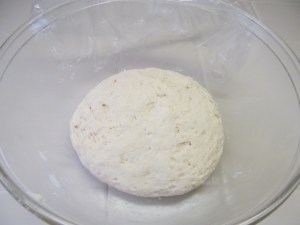
Leave the dough until it has risen to twice its size, probably at least 45 minutes, maybe an hour or so. Knock it back, which means knead it enough to just get some of the air out of it. Leave it alone for another 20 minutes or so.


Dough often sticks to your hands and on the surface you are working on so people use oil or flour to help prevent that. I used oil on my hands and flour on my board. Divide dough into 6 equal pieces, form into balls, and then flatten into rounds.


Add a generous tbsp, or as much as you can fit, to the center of the flattened ball of dough. Fold over from the edges to the middle and seal the dough together by pinching it. Make sure no filling is coming out anywhere.


Heat oil in pan, med-high heat. Add a ball of dough, let cook for 30 sec – 1 minute and then flip over. Gently but firmly squish dough ball flat. Koreans use a special press but I just use the back of my flat, fried egg turner.


Let cook until slightly golden brown, turn back to first side and let cook. You can add 2 or three to the pan at one time, just remember they get bigger when you flatten them.


Since they are best served warm I have a second pan on a low heat where I place them once nicely golden on both sides. I use a lid to keep the heat in and to lightly steam them to finish off the cooking and melting of the filling. Once they are all done, the call goes out and the line forms.


Caution, filling will be hot.
If you have any leftovers they can be heated for a few seconds in the microwave. You can also add different types of fillings and lately there has been a trend for cheese and savory fillings. I have yet to try these, but will do doubt do so. Let me know if you have a favorite filling or recipe in the comments below.
Have a great day everyone.
Is It The Kdrama Actor?
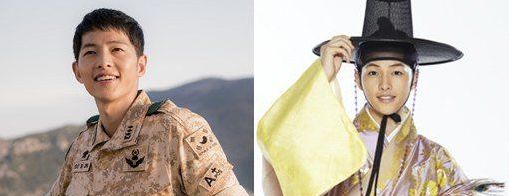
Or is it the character that they portray that you like?


I think we probably all have a long list of our favorite Kdrama actors, especially when we have such a large selection to choose from, but have you ever stopped to think who are your favorite characters. The characters who you wait to see appear, the ones who add humor at just the right time, or those who are just perfect, or who were created be your soulmate.
Once I began to think about it, I realized how often it is those characters who make or break a drama. If there’s no best friend, second lead, comedy relief, or villain there often isn’t really much of a story. A pure love story with no conflict, misunderstood actions, or competitors in the game of love would be somewhat short and boring. And if these surrounding characters are well written, and are acted out well by the actors, then we have characters that take on a life of their own, and draw us into the story being told.

The actor Lee Hong Ki played a band member of the idol group A.N.JELL named Jeremy in the drama You’re Beautiful. Although a central character he was not the first or second lead, but in many ways he made the most impact when on screen. I think we all loved Jeremy, he was innocent and sweet, kind and a little bit gormless. He wanted and needed someone to love, and someone who could love him back. He had dreams of romantic love and didn’t know how to react when he began to have feelings for the new band member, a girl playing the part of her brother. He was confused and scared, but eventually he accepted that love is love. Along the way we saw Jeremy struggle as he added comic relief, anger, tears and loyalty to the drama. I’m not sure I would have enjoyed You’re Beautiful as much if there had been no Jeremy. Think about it and try and imagine the drama without him, it’s hard isn’t it. He was so popular with many fans than when Lee Hong Ki appeared in a cameo in the Kdrama My Girlfriend is a Nine Tailed Fox everyone said it was actually Jeremy.
So is Lee Hong Ki a good actor, of course he is, but do I remember the actor more or the character. In this case I can definitely say the character. As far as I can tell Lee Hong Ki and Jeremy are poles apart on many traits and characteristics, and although a good actor is meant to make us forget him, and remember his role, that is not always easy to do, which is why so many actors get typecast in certain roles because studios know audiences can then more easily believe how they act in the drama or movie if they always play a similar type.
John Wayne never died in any of his movies until towards the end of his career because at that time John Wayne, the hero, couldn’t die. When he did eventually die in the movie The Cowboys people were shocked and horrified. John Wayne had become bigger than his characters. This is why you will often see actors take on challenging roles such as villains because of a fear of being typecast. Studios want the same winning formula time after time and so it becomes a struggle for the actor to play against type. But I digress, I’m sorry.
There are multiple characters who I believe really added to a drama, and whether those characters would have been better or worse with a different actor playing the part, who can say. And maybe that is what happens, the right actor plays the character in the right way, and a ‘person’ is born. Born in the sense that we do forget the actor and only remember the character.

I remember Oska from Secret Garden although I’m somewhat embarrassed to say I can’t remember the actor who played the part. (It was Young Sang Hyun) Oska was a ‘bad boy’ in some senses, but he was unswayable in his loyalty and concern for his cousin even though it was all masked behind teasing and competition. He was a character with faults, but he wanted to be a better person. He was engaging and was a perfect foil to the love story of the two lead characters, which occasionally became a little exclusionary even perhaps to the audience. In a way I hope he never changed much after the drama ended.
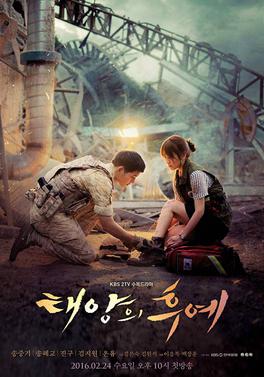
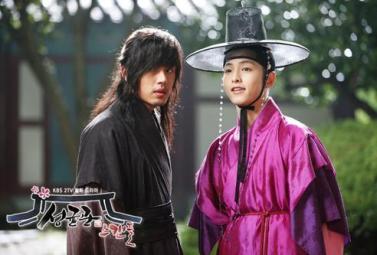
Sometimes I love the character, and the actor, which can make it hard to know which I really like, this is especially true of a versatile actor like Song Joong Ki, more so because I also loved him on the Variety Show Running Man where he showed more of his real self. So when I watch him act I have to work out how quickly do I forget he is Song Joong Ki and how quickly does he become Captain Yoo Si Jin in Descendants of the Sun, or playboy dilettante Goo Yong Ha in Sungkyunkwan Scandal. I loved both of those characters and their bromances with their best friends. A close friend of the lead is often a necessity to further plot and character development, but many times it can become more than that. In some ways it becomes a secondary love story, one between brothers, sisters, or close friends. There is no way to doubt that there is love between Captain Yoo Si Jin and Sgt. Seo Dae Young, they support each other and would even die for each other and this is part of what makes these characters real and alive, we believe in their love, friendship and commitment to each other. The love story is all well and good, but it is these parts outside of the main romance that can make a drama great and this duo makes me so wish for a friendship like that.
Captain Yoo and Goo Yong Ha are totally different from one another, with one being an upstanding, competent military man, and the other a clever, manipulative playboy initially only concerned with his own enjoyment. One the dramatic lead, the other a sly and mercurial friend to the second lead, yet both characters had their own charms. Even with his flaws Goo Young Ha steadfastly stood by his best friend, even risking his life and future to do so. Both Cpt. Yoo and Yong Ha had their own smiles, that’s how well Song Joong Ki became each character. Which do I like best, well maybe Goo Yong Ha, but I would go out drinking with either of them.

There are so many other characters I like that perhaps I should do a part 2 and talk about how funny characters like Choi Cheon Sang and Kim In Rang in Let’s Fight Ghost add laughter to an otherwise serious tale, or how Kim Shin Hyuk in She Was Pretty was funny, and sad, and annoying all with a blink of an eye. Or how more traditional lead role characters such as Dok Go Jin in Greatest Love, or Choi Han Kyul in Coffee Prince made us fall in love. But in the meantime is there a character who you think became ‘real’ to you? One who you liked more than the actor playing the part? Or do you like a character mostly because of the actor who is playing the part?
Please comment below as I would love to hear your thoughts.
Have a great day everyone.
You might also like Hwarang: The Flower Boys of Silla, and The Best Korean Dramas, (so far this year.).
Photo credits to original owners, probably – You’re Beautiful. SBS Secret Garden. SBS Descendants of the Sun. KBS Sungkyunkwan Scandal. KBS
Archery In Korea.

The practice of archery has a long tradition in Korea, and with the recent Gold Medal wins for both the Men’s and Women’s archery teams in the Rio Olympic Games I thought I would share a little about its history. This is the eighth consecutive Gold Medal in the Olympics for the Korean Women’s Team since 1988. Wow, just wow, the pressure must have been intense. Note the Olympic team does not use traditional Korean bows, but standardized modern recurve bows. Modern compound bows are not yet allowed in Olympic competition.
Civilizations from all around the world, except for Australia, developed and used archery, with the oldest extant bow being from Europe from around 8,000 years ago. The oldest known composite bow (made from a number of materials, not just a piece of one wood) was made by the Ancient Egyptians about 5,000 years ago, and records show that the Chinese were holding archery competitions during the Zhou Dynasty. (1027 – 256 BCE) Archery was much needed tool for many cultures and its invention has been compared to the use of fire and the invention of the wheel. Bows and arrows dramatically improved man’s ability to successfully hunt many animals and birds, thereby increasing the available food supply. They also are efficient for both attacking and defending oneself, so military use no doubt quickly followed their invention. Bows and arrows do vary from culture to culture and improvements in equipment and techniques have changed over time.

Archery has been used and enjoyed by Koreans for centuries. No one quite knows when archery was first practised on the Korean peninsula, but it has been posited that it was probably around 5,000 BCE. (Some Koreans give 500 BCE as first definitive proof of archery in Korea, but I have been unable to ascertain why.) The first written work that mentions archery in Korea is from the first century BCE.
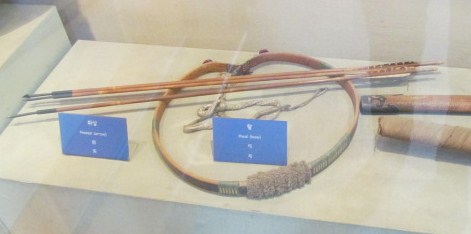
Korean traditional bows fall into the Recurve category of bows, meaning that the whole bow curves away from the archer forming a C or even an O shape when unstrung. The advantages include being maneuverable, easy to carry, and being faster than other bows with the same draw weight (how hard it is to pull back) and length (how far back you have to pull the bowstring.) They are sometimes called reflex bows because of their extreme curve back upon themselves. Bows in this family are often called horse bows or hunting bows. Korean traditional archers used thumb rings to protect themselves from injury when loosing the arrow, and they shoot from the right side of the bow.


The bow you see in Robin Hood movies is a Longbow and was popular in medieval England, while the standard Recurve bow was used by the Mongols among others. You can obviously hunt with all bows, but some types have proved better for different uses. The English Longbow could pierce armor at short distances and kill a man at long. The Mongol bow was mostly used from horseback. The Ancient Egyptians, and others, used archers in chariots, while archers on war elephants were used by both the Indian and Assyrian armies. The Korean bow was used both by foot and mounted soldiers, as well as on warships, and proved effective for all these uses. Modern bows are usually classified as Compound bows.

Numerous Korean Kings were renowned for their archery skills and archery was seen as an essential skill for a gentleman. It was one of the Six Noble Arts in China and this idea was also prevalent in Korea, particularly for those who followed the ideals of Confucius since he had once been an archery teacher. During the Joseon Dynasty (1392 CE – 1894 CE) archery was an integral aspect of the National Service Exam to enter public service.

Over time there were advancements in Korean archery and the pyeonjeon was a particularly useful development. It was a little arrow that used a tongah or a partial tube of bamboo as an arrow guide. By using this the arrow went a long distance and had good penetrating force. The pyeonjeon was used successfully against the Japanese in 1592 and the Manchus in the early 1600s.
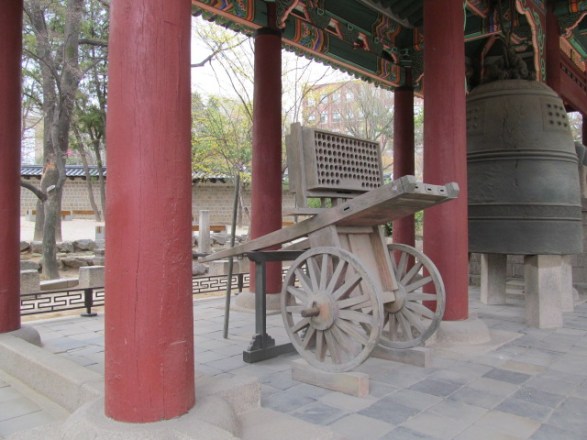
Another development that used arrows, but no bow, was the hwacha a kind of hybrid rocket launcher for both steel tipped arrows and arrows with small packets of gunpowder attached to them. About 100 of these fire arrows could be fired at one time. They were more of a defensive weapon since they had a short range, but were effective against the Japanese during the Imjin War.(1592-1598)

Under King Hyojong (1619-1659) there were attempts to revive horse archery, which had seen a decline, not only for military use, but also for pleasure and for health benefits. Many people took up archery as a recreational sport in which even certain women could take part. Even after guns came into use archery was still used by the Korean military up until the reforms of 1894. Under many conditions archery was still a feasible option for the Korean military up until that date. When Korea opened to the West things changed dramatically.

In this fantastic 18th century painting by Kim Hong Do you can see how archery continued to be a popular pastime, although it was Emperor Gojong (1852-1919) who oversaw the complete transformation from a military skill to a fully recreational sport. This time period saw the basics for the modern sport develop. Bows and arrows were standardized as were target distances, and number of arrows shot for each round. There are numerous traditional archery ranges in Korea and archery is still popular with Koreans, if not as a participatory sport then as a viewing and emotional one. Koreans are extremely proud and protective of their national and traditional sports. In 1971 the art of traditional bow making was declared a part of their Intangible Cultural Heritage.

Olympic athletes use modern recurve bows, however many of the younger generation and archers around the world use modern compound bows. Debate continues among the advocates for each style of archery although I must admit I have a fondness for the more traditional styles. I particularly enjoy watch horse archery competitions and am glad to see a resurgence of that aspect of archery. The Hungarians and South Koreans are both known for being great horse archers, although in recent years the sport has caught on in other countries such as Australia and competition has become fierce. If you ever get a chance to watch it is a lot of fun.
Korean archery appears in movies, most Korean Sageuk, and many period dramas, with some nice coverage in Sungkyunkwan Scandal which shows an archery competition. Archery also appears in some of the idol sports programs which helps popularize the sport as well as entertain the fans. In Olympic years the popularity of sports in which Koreans do well in the medal count often see an upswing in young people taking up the sport. Archery will no doubt see that following the excellent team showing. Individual competitions are going on as I type this and the pressure is on the Koreans to perform well. ‘fighting.’
Have a great day everyone.
You may also enjoy Horseback Archery in Korea, Tuho, and Ssireum.
Please do not copy or use without permission and accreditation.
All photo credits to original owners. Where I found them in order. BBC.com for Women’s team photo. Kdrama Empress Ki. MBC. My photo from Korean National Museum. Medieval Longbow on Pinterest. Mongolian archer 15th century on wikipedia. War of Arrows Movie on Pinterest. Kdrama Sungkyunkwan Scandal. Horse archer Pinterest. Artist Kim Hong Do.
Bibim Guksu: Korean Cold Spicy Noodle Salad.
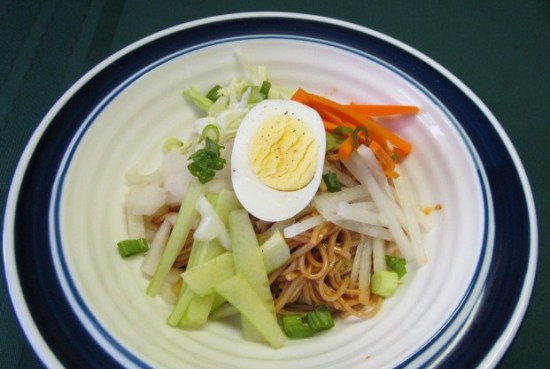
The dog days of summer are upon us and it has become increasingly hard to get enough energy to do anything, let alone being in the kitchen cooking. Here in Texas we’ve have temperatures hovering around 100 degrees for days on end, the grass crunches when you walk on it, and barely a single cloud darkens the never ending blue of the sky. But we’ve all got to eat, and regular salads can become boring after a while, so here’s a recipe that can spice up your life and get you out of the summer doldrums.
Bibim Guksu is a delicious cold spicy noodle salad that is simple to make. You can use various types of noodles although buckwheat noodles are probably the most traditional. You can use whatever vegetables you have on hand as long as they can be eaten raw, or you can use leftover cooked vegetables straight from the fridge. The trick is that you want everything to be nice and cold.


Cut some cabbage into small pieces, julienne a couple of carrots and half an English cucumber. Place to one side. Julienne some daikon radish.


Cook your choice of noodles according to package directions. I used Buckwheat noodles. Drain noodles, rinse with cold water, cover and place in refrigerator.


Cut up some spring onions, and an Asian pear.


Place all you prepared vegetables and fruit in the refrigerator while you prepare the dressing. Place 3 tbsp of Korean red chili paste, 4 tbsp rice vinegar, 2 tbsp soy sauce, 2 tbsp honey, 2 tbsp brown sugar, 2 tbsp toasted sesame oil, and 2 tbsp toasted sesame seeds into a bowl and mix together thoroughly. Mix together noodles and dressing.
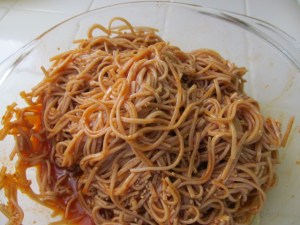
Place a serving size into a bowl and add the vegetables and fruit. Garnish with half a hard boiled egg.


Being Texas we eat a lot of meat so I added some cold marinated beef and chicken to my bowl. Mix everything together and enjoy.
Everyone have a great day.
 KPOP Jacket Lady