KPOP Jacket Lady
KDrama and KPOP Concert Reviews, Travel Tips, Korean Recipes and more
Korean Variety Show Games, Part 2.

In Part 1 I talked about how games are often the backbone of many Korean Variety shows, with some games playing a recurring role. Running Man is the home of the name tag game to the point it has become synonymous with the show itself. Many games pop up randomly from time to time while yet others appear with some regularity. Quite a few games require little in the way of equipment and can be played at home or at the park.

The leg stretching team game requires little more than a starting line and a way to mark the final distance of each teams efforts. Each team must stretch their legs as wide apart as possible and line up toe to toe as shown in the photo above. The team who stretches the furthest wins. This sounds very simple, but since the first players must hold their legs stretched out until the whole team has formed up, it can be difficult. If players are not touching toe to toe they are eliminated from the game, or they must reform the line and a new measure taken. Players may balance themselves with their hands, or not, depending on ‘house’ rules. Multiple teams can play this game.

This next game doesn’t show up as often as I would like, but it is an easy game to play at home, and a lot of fun to watch. My favorite example is from 2PM who played this game in their PJs. It can be played with cookies or with slices of pickled radishes, and the aim of the game is to maneuver the cookie or pickle down from your forehead into your mouth just using your facial muscles and gravity. No hands allowed.

Butt wrestling or butt shove is a silly and fun game that require no equipment. Two people stand back to back with butts almost touching and when the whistle blows they must try to knock the other person off balance just by using their butts. House rules can determine if feet must be together or not. A wider stance leads to more stability for the players. 2 Days 1 Night has fun with this game as does the Kpop idol group UKiss.

Egg roulette is a very simple, if potentially messy, game. All you need are a dozen eggs, 10 hard-boiled and 2 raw. This number can be changed depending on how many people are playing. Each player takes turns choosing an egg and ‘smashing’ it on their forehead. The person who chooses the raw egg loses. Players should be warned not to hit the egg onto their head with too much force and you should have clean up supplies handy. This game is not only popular on Korean shows, but you can also see it on American shows as well.

Another simple game is tossing something like a coin or even a bottle cap into a bowl. Bowls work better than buckets because the coin/bottle top is more likely to bounce out making the game harder. To make it easier you can fill the bowl part way with water. In Ancient Rome a similar game was played where small pebbles were tossed into a narrow top clay jar, so simple games like this have been around for thousands of years. Running Man players are well known for ‘bending’ or even breaking rules, so make sure to specify your ‘house’ rules before you begin to play.
Have a great day everyone.
You may also enjoy Part 1, Part 3, Yut, Alkkagi, Jegi Chagi, Kai Bai Bo, Ssireum, and The Humor in Mud.
All photo credits to original owners. Please do not copy or use without permission and accreditation.
Baduk, the Korean Game of Weiqi, or Go.

Like many people, the first time I ever heard people talk about this ancient game they called it Go and said it was Japanese, but that’s not quite true. Japan has had a huge influence on the game, but they did not invent it. According to creditable historians, archaeologists, and researchers it originated in China sometime before the 4th century BCE when we have the first written record, in Zuo Zhuan, of the game. Some place its’ origin at a much earlier date, and that might be so, but without extant boards, paintings, or written records from before then an earlier date is hard to prove. Legends place it much earlier, as much as 5,500 years ago. The game was also not called Go, but Qi,(or Yi) and later Weiqi. The Confucian Analects from the 4th century BCE also mentions Qi, but in the general sense of ‘game’ so maybe not specifically Weiqi as other games were played in China at this time. Nevertheless I think it fair to say that sometime before, or around, 2,500 years ago the upper classes in China were playing Weiqi. It was one of the four attributes of a scholarly gentleman, to be a master of music, Weiqi, calligraphy and painting.

Baduk is the name given to Weiqi in Korea. It is not known exactly when the game reached Korea from China, but it was probably sometime around the 5th century AD, although considering the long relationships between China and her neighboring states it may well have been earlier. In the retrospective history book Samguk Sagi written and compiled in 1142-5 AD from earlier more ancient texts such as Sima Qian, Wei Shu, Sanguo Zhi, Jui Tangshu and others, a story about Weiqi is recounted as having taken place in AD 475. In it a renowned Baduk player, who was secretly a spy, was sent to the court of the Baekja King to try and influence him into making poor decisions leading to the eventual weakening of his kingdom to the extent that Goguryeo King Jang Su was able to defeat him and take his kingdom. The Samguk Sagi recounts several other stories were Baduk/Weiqi is mentioned. The Samguk Sagi was written in classical Chinese, the language of the literate elite of the time so I’m not sure if it was specifically called Baduk at that time, or was still known as Weiqi.

Chinese sources such as Sindang-seo Xin Tang Shu and Huo Zhou Shu also attest to the fact that Baduk/Weiqi was played during the Three Kingdoms period (57 BCE -AD 688) of Korean history. It continued to grow as a game and a life skill for the ‘yangban’, the ranked civil and military upper class elite, and was soon seen in Korea as being necessary for those seeking advancement. Scholars incorporated references and analogies to Baduk in their poems and literary notes while wealthy families hired teachers to ensure that their sons received adequate instruction in the four gentlemanly arts. A good Baduk player was always welcome in any social situation. Many kings, princes, senior ministers, generals and scholars were known to have played, as well as some kisaeng and courtesans.

The early forms of Weiqi/Baduk often were played on a 17 x 17 grid and it took some time before the 19 x 19 board became the standard size. The board on the left is from China and dated to AD 182, while the board on the right is dated from the mid 7th century AD and was a gift from Baekja King Uija to a Minister in Japan. It is the oldest wooden Weiqi/Baduk/Go board in existence. Japan was the last of the ‘big three’ to learn of the game, probably in the 7th century AD. There are many good articles on Go in Japan if you are interested in learning more about its’ spread and explosive growth there.


Sometime during the 16th century Baduk in Korea changed from the Baduk/Weiqi traditional method of play and a form called Sunjang Baduk became popular. In this form the first 16 moves were already determined, a bit like in a game like Chess where the pieces are already on the board and you start play from that setup. (A lot of very old games didn’t start with pieces already set up on the board as the process of where you placed your first pieces was important to how the rest of the game was played. Nine Men’s Morris is a good example of this, as obviously is Weiqi.) Sunjang Baduk was also scored differently and the whole game was said to produce more aggressive, but at the same time more pragmatic players.
The traditional/international method of play returned to Korea in the late 19th century with the Japanese occupation of Korea. Both methods of play existed for a while, until gradually the Japanese method became the most popular with ‘modern’ Baduk finally taking over in the late 1940’s with the founding of privately organized associations such as the Hansung Kiwon. In 1955 the Korean Baduk Association was formed and official tournaments soon followed. The next few decades saw the public acceptance of the ‘new’ Baduk and the number of players began to increase, as did the quality of those players. Some players went to Japan and brought their new knowledge back with them. By the late 1980’s/early 1990’s Korea was beginning to challenge on the world stage. By 1996 it was acknowledged that Korea had some of the best players in the world as they dominated many competitions and international tournaments. Many of the top players are professionals and make their living by playing in such competitions and tournaments, but with the success of the professional players there has also been an increase in quality amateur players as well.
Korea still has some of the best players in the world, but China has seen an increase in good younger players lately and are regularly producing tournament winning players. Sadly Japan is falling behind these two powerhouses of the game.
There are multiple sites online on how to play Weiqi/Baduk/Go and it is one of those games that ‘is easy to learn, but hard to master.’ Although Chess players will no doubt disagree, mathematicians and game players alike say that Weiqi/Baduk/Go is the more stylish and complex game to truly master. It has been likened to a long duel played in the form of a game.
Have a great day everyone.
You may also enjoy Alkkagi, Yut, and Omok.
Please do not copy or use without permission and accreditation. Photo credits to original owners.
Korea Without The Chili Pepper!
It is surprising to realize how many people believe that the chili pepper is native to lands where it was in fact unknown of until about 500 years ago. Korean, Indian, Thai, Hungarian and all other Old World cuisines which are famous nowadays for their spicy food and use of the chili only developed their ‘signature’ dishes relatively recently compared to the span of human history.
The chili pepper was part of something called the Colombian Exchange, (after 1492 AD) which was when early visitors to the New World, (North & South America) took their plants, foods, and diseases with them to the New World, and brought plants, foods, and disease from the New World back to the Old. (Europe, Asia, & Africa). The most famous products from the New World included, potatoes, tomatoes, peppers, corn, turkey, pumpkins, tobacco, and more, while the New World received coffee, sugar, olives, horses, pigs, smallpox, wheat and more. This ‘exchange’ is named after Christopher Columbus although the travel of goods took place over many years and involved sailors and ships of many nations.  For the story of the spread of the chili around the world one has the thank the Portuguese and Spanish Empires. These two nations competed to claim land both westward towards the New World and eastwards into the depths of Asia. India was one of the first countries to really accept the chili into their cuisine, and they are still the world’s top producer, consumer and exporter of chili peppers. Chili peppers were native to the area around the highlands of Brazil and were also unknown in N.America until they traveled north with the Spanish. By 1500 AD there are records of the Portuguese regularly exporting chilies from Brazil. The chili spread around the world like wildfire. By 1540 the Portuguese were trading in chilies in Indonesia. One odd fact is that Hungary, another country famous for its use of chilies, didn’t originally receive them from Europe, but when they spread backwards from India.
Chilies contain a chemical that is somewhat addictive. This chemical tricks the brain into thinking the ‘heat’ is dangerous and so releases endorphin which is a natural painkiller. This is partially why some people eat chili peppers, because they feel better afterwards. Chilies are eaten by more than a quarter of the world’s population every day, and may be the most used spice.
It is difficult to determine exactly when the chili reached Korea. Some historians claim they spread from China, while others suggest that they were introduced to Korea from Japan. (Edit. A recent food historian says the first mention of chili peppers in a Korean book was in 1527, although this does not necessarily mean that chilis had reached Korea and were being consumed.) It is thought that in the 1540’s Portuguese Catholic Missionaries introduced the chili pepper to Japan and Korea probably became acquainted with them soon after through trade and later by the Japanese Invasions of Korea, (1592-8). Although Korea was familiar with them at this time under the name of Japanese Mustard they could not get a hold of any seeds with which to grow the plants themselves, as Japan was tightly holding on to their monopoly. King Sonjo (reigned 1567- 1608) repeatedly asked the Japanese and was rejected. Somehow Korea did however get a hold of the seeds, and the pepper plants liked the soil and climate and Koreans everywhere began to grow them and incorporating them into their cuisine.
In 1614 Yi Sugwang, called chili peppers ‘a great poison’ so not everyone took to them immediately, but he goes on to say that they were often served in drinking-houses, so his comment may be a class bias statement. His comment is, however, useful as it shows that by 1614 chili peppers were widely available in Korea. So in just over 400 years chilies have become so tied up in the Korean way of life and it’s cuisine it is hard to comprehend that it wasn’t always so.
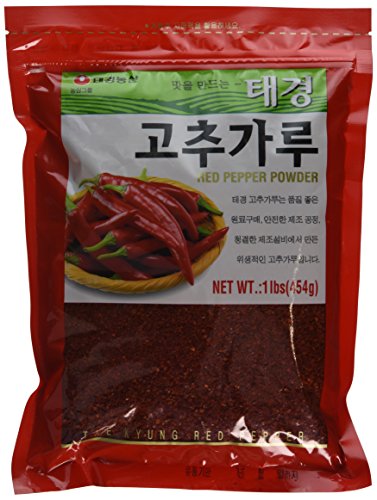
Personally I love spicy food, although mostly in the mid range of heat, so eating out in Korea is something of an adventure. I love the flavors, but can’t always take the heat. It was the same for me in Hungary and Mexico, but fortunately someone usually takes pity on me and gives me some yogurt, milk or bread to calm the heat, and I’m back out the next day savoring that addictive food I love so much.
Have a great day everyone.
You might also like Korean Salt, Korean Salt. Rice: Feeding Half the World Everyday, and Open Sesame.
Photo credits to me and/or original owners. Colombian Exchange map and Early Exploration map found on Pinterest.
+HELLO BI+CHES TOUR 2016 + DALLAS

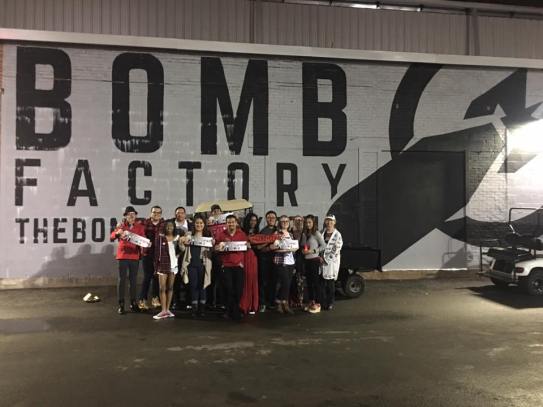
CL also known as Chae Lin Lee, or the ‘Baddest Female,’ stopped in Dallas this past Sunday as part of her 9 city North America Tour. CL is maybe better known to some as the leader and rapper in the mega popular girl group 2NE1, but she is well on her way to becoming a superstar in her own right as a solo performer. The concert was at the Bomb Factory in the Deep Ellum area of Dallas and even in the occasionally heavy rain fans lined up for hours before the doors were due to open.

In homage to her roots the pre-show warm up consisted of big screen videos of some of 2NE1’s most popular and iconic songs, plus some of CL’s solo work. The crowd got into the spirit and sang along to their favorites, cheering loudly as their individual biases sang their solo parts. It was heartwarming to see that all the members of 2NE1 received loud cheers and love from the audience even if we were only seeing them on video.
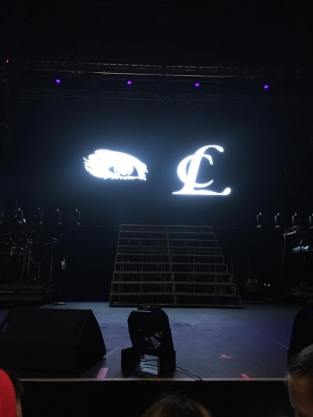
The audience was all ready and primed when CL appeared on stage to a loud roar and screams from the crowd. She performed an explosive intro medley of Fire and Can’t Nobody, all the while encouraging the fans to jump and build up the excitement and energy level.

She followed with Scream, and then as just a few notes began to play she asked “do you know this song?” It was of course I Am The Best, and we did indeed know it. CL encouraged us to singalong and let us sing some parts ourselves. This was a trend throughout the whole show which made us all feel involved while also having the side benefit of her being able to slightly rest her voice. Other fan favorites followed including I Don’t Care, Gotta Be You, and Come Back Home all of which were received well and enjoyed by the audience.

The show could be roughly broken down into 3 segments and 3 outfits. The first part was 2NE1’s mostly up tempo songs, the second was ballads and slower songs, before the last segment which was pure CL.

For me the highlight of the middle part was Lonely. Considering her beginnings as 2 NE1’s rapper she did remarkably well as a vocalist, with me noticing only a couple of times when her voice wasn’t quite perfect, which can be said of many artists while performing live. She has a lovely voice as a singer, as well as a powerful one, which the audience appreciated. I think it can safely be said that she proved the naysayers wrong with the performance I witnessed. She was perfectly capable of holding a 90 minute performance by herself, although I will add that she had excellent backup dancers and musicians to accompany her.

The third part of the show was all CL and she slipped into her ‘Baddest Female‘ role with ease. The crowd was pumped up and screaming and singing along with gusto. Red light sticks kept the beat with red waves crashing throughout the crowd. The only downer in the whole concert for me was Dr. Pepper which I consider a sub par song, although many in the crowd seemed to enjoy it. I’ll be glad when she has a bigger repertoire of songs so that one can be relegated to her B list.

After the ‘main’ show, the encore was Hello Bitches and Lifted which nicely rounded out the night on a high point. It took a while for the audience to disperse as many called out hopefully for another encore or stood around chatting with their friends about the concert. This is when I noticed that this concert had ‘credits’running on the big screen behind the stage. I thought this was a cool idea and that it should be done more often. It does, after all, take many people working together to put on a successful performance.

While I didn’t particularly like CL’s outfits, what I did like is that she looked like a fit and healthy young woman, not a stick thin waif. She was beautiful and had an amazingly expressive face, being able to change it to suit the mood, and to shoot sexy looks to the audience at will. But she was at her most lovely when she was having fun, which seemed to be throughout most of the concert. Her easy going smile and the way she engaged the audience was natural and effortless. She was a joy to watch.

It was a great concert and enjoyed almost every moment of it but my favorite part of the night was the Meet & Greet that took place before the show. CL spoke with everyone, hugged almost everyone, and had a smile for everyone. She spoke a few words to me about my jacket, but she spoke personally to almost everyone of the 200 people at the Meet & Greet, and that takes class.

I was also lucky to meet and hang out with some great people, from my SXSW line buddy and friend ‘Sangheili19’, to new friends made over a delicious meal the night before the concert, to new friends made through the group that gave CL the bag of Texas goodies, to random people in line who shared umbrellas, pizza, and friendship. Thank you all.
Have a great day everyone.
Photo credits mostly to ‘Sangheili19’ (check out his youtube channel ) and me, with the photo of CL in cowboy hat being from her Instagram. Please do not copy or use without permission and accreditation.
You may also like SHINee Shines Bright in Texas, and Got7:Fly in the USA.
Korean Variety Show Games, Part 1.


One of the things that many fans of Korean Variety Shows, such as Running Man, 2 Days 1 Night and Infinite Challenge, love are the games. Games, challenges, contests or whatever you want to call them make up a large part of these shows content. Food and social interaction are also important and some games like Food Bingo can incorporate both those things. Celebrity guests and interesting locations add to the appeal too.


I have already written about some of the traditional games played on these shows, namely Yut, Ddakji, Gonggi, Kai Bi Bo, Tuho, Alkkagi, and Jegi Chagi, but there are so many more. Quite a few are short quick games to choose who starts a longer game. Games like Kai Bi Bo or Odds and Evens are often the type of game many of us played on our school playgrounds to decide who would go first. Many games have regional variations and ‘house’ rules so make sure you’re all playing by the same rules.

Cham Cham Cham aka Di Bi Di Bi Dib is a popular game on variety shows and with idols alike. It is very simple, but surprisingly hard to win as instinctively our head will turn in the direction the opponent is pointing. Yoo Jae Suk often takes the game to a whole new level in Running Man and much humor ensues. The rules are quite straightforward. Two people stand, or sit, facing each other. A quick pre game of Kai Bi Bo or something similar might take place or one of the two players just decides to start first. Whoever starts first will chant Cham Cham Cham, or Di Bi Di Bi Dib, and then with their upheld hand, or sometimes some kind of prop, point right or left on the last Cham, or Dib. If their opponent’s head turns the same way as their hand then they win, if the opponent’s head turns the opposite way then the opponent wins. Most losers receive some kind of punishment, which can range from gentle to severe. There is also a version where the choices are up and down as well as left or right. This statistically gives the one choosing the direction a disadvantage and so works better for group play as opposed to 1 v 1.
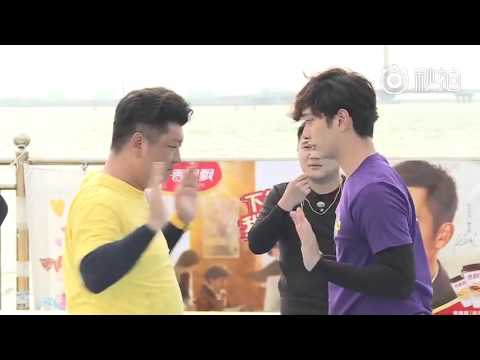
I’m not sure of the Korean name for this game, the US Boy Scouts call it the palm pushing game, but I think that maybe is just a descriptive name they’ve made up. In someways it is not totally a palm pushing game as your hands are meant to be more of a shove and release, your hands are not meant to stay in contact after the initial push/shove. Two players face each other with their toes about 2 shoe lengths apart from their opponent. Some rules say each opponents own feet must be together, which make the game much harder, or just a comfortable foot or so apart. The wider the stance the harder it is to knock someone off balance. Hands should start by being held about armpit to shoulder height as in the photo above. Each player is trying to knock the other off balance so that a foot moves out of place or the player loses balance and falls. Once the game starts no turns are taken, both players are watching and waiting for an opportunity to strike and the game is usually over quite quickly. Hands can be moved away from their starting position to evade the opponent’s strike, but palms must always be facing your opponent. To get the idea of the game it is best to watch a few examples. Please note that if you play boy v girl boobs might accidentally get touched if opponent overbalances forward. Also a hint is to keep you hands more to the sides than directly in front of you.
A similar game is where you push each other’s forehead, with the best ever example of this game being by Daesung from BigBang. It still one of the funniest things I’ve ever seen.
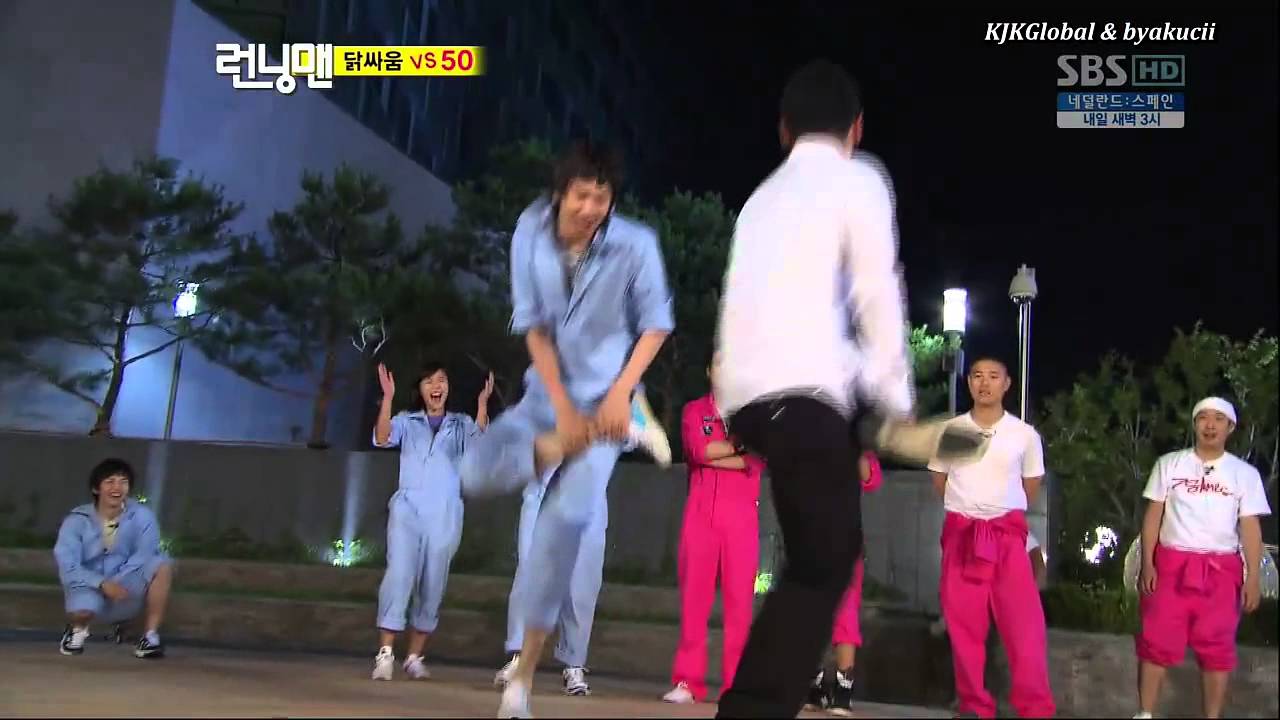
Another perennial favorite is the Chicken Fight Game, again more of a description than a name. This game requires flexibility and a great sense of balance. It also helps if you are quick to spot your opponent’s weaknesses. You can use strength, speed and strategy. Sometimes it is good to hit downward with your knee, or a strong player might try and lift his opponent off balance by striking upwards under the opponents knee. Usually there is some sort of boundary around where the game is played and knocking someone out of bounds is also a winning move. This game can be played one v one although it is often played as a team game. There are slightly different versions including one group version called, Protect the King.
There are so many more games that are played on Korean Variety Shows, that this will no doubt be an ongoing theme. If you have a favorite game you’d like me to write about in part 2, please let be know in the comments below.
Have a great day everyone.
First 2 sets of photos to me. All others photos credits to original owners. Please do not copy or use without permission and accreditation.
You may also like part 2, part 3, and part 4 and Korean Variety Show Games: Lose And Face The Punishment.
My Favorite Parks. (Actors not green spaces.) Edited and Updated January 2019.

I mean actors named Park not public parks, although one day I should post about those too.
As many of you know there are a lot of people with the surname of Park in S.Korea as it is one of the top three most common surnames in the country. Kim is in first place, Lee in second and Park in third. These three surnames belong to more than half the population, which of course means there’s a lot of Korean actors with the last name Park. They range in age from child actors to more senior ones.
One the left is Park Ji Bin and on the right Park Hyuk Kwon.


My favorites fall somewhere between those ages. It is hard to list them all numerically as a new role or performance might change my mind, or even a scandal or learning something bad about their character. So in no set order my favorite ‘Parks’ are Park Bo Gum, Park Seo Joon, and Park Hae Jin. Other Parks I like include Park Hyung Sik ,Park Min Woo, and Park Sung Woong, along with a few comedic and supporting actor Parks like Park Ki Woong. There’s even a few Kpop idols named Park who are beginner actors like Park Chanyeol and Park Jin Young who I’m keeping my eye on.
Park Bo Gum.

Park Bo Gum is a young actor, only 25 years old, who enjoyed tremendous success and popularity for his drama Moonlight Drawn by Clouds. That drama may have put him squarely in the public eye, but many of us have been enjoying his acting since his debut in 2011. He was in a couple of movies such as Blind, and Runway Cop, and the TV drama Bridal Mask as well as others. But he first popped up on many peoples’ radar in Tomorrow’s Cantible where he caused some serious second lead syndrome among viewers. Since then he’s been in more movies and dramas, including Hello Monster and Reply 1988, as well as co-hosting on Music bank, and appearing on variety shows. His latest project is the Kdrama Encounter. He also has been, and is, a popular endorser of products for big name companies such as Sony, K.Swiss, and Domino’s Pizza.

Couldn’t resist showing friends Park Bo Gum and Song Joong Ki together, whole lot of handsome going on right there.

Park Bo Gum has received lots of awards in his relatively short career, including Best Newcomer Awards, Best Supporting Actor, and others including an Asia Star Award. I agree he is deserving of these awards as he is a good actor, but for me I think it is his smile. He is a versatile and engaging actor and has a multitude of great facial expressions, but when he smiles he just lights up the screen and oftentimes makes me smile too. I hope to see him in many more leading roles.
——————————————————————————————————————————–
Park Seo Joon.

Park Seo Joon has been around a little longer than Bo Gum and he also has has a nice smile. (Maybe there’s a trend in which actors I like? Probably.) Park Seo Joon is 30 years old and completed his mandatory military service in 2010 before his debut in 2011 in a music video. He then got a part in Dream High 2 followed by Pots of Gold and then Witch’s Romance. He really came to the forefront and grabbed my attention in Kill Me, Heal Me, and then I also enjoyed him in She Was Pretty.

I enjoyed seeing him in historical clothing and long hair in Hwarang, The Beginning, which aired at the end of 2016 beginning of 2017. This drama also had Park Hyung Sik in the cast so double Parks.

2017 saw him in the romantic comedy drama Fight For My Way, which had the added bonus of seeing his muscular body on more than one occasion. He also appeared in the movie Midnight Runners which was a cop buddy romp which tested the appeal and capabilities of the two main leads. I enjoyed it.
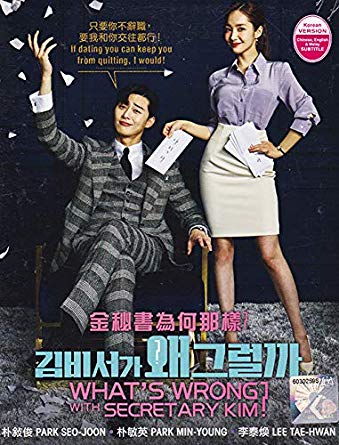
In 2018 the highly rated What’s Wrong With Secretary Kim? put him firmly at the top of the rom-com list for me. He can be silly, and comedic and then turn around and make you believe he is the most handsome romantic lead and totally understand his tug on the heroine’s heart. Perhaps because he doesn’t want to be completely typecast I hear his next movie is an occult mystery set for release in 2019.
I’ll be watching out for all his future projects.
___________________________________________________________________________________________
Park Hae Jin.

I really enjoyed his acting in the 2014 Bad Guys and then the 2017 Man To Man. Even though I had known about his acting from multiple dramas for many years it was not until these two that he became one of my favorites.

He was born in 1983 and debuted in 2006. He had pretty much an instant hit with Famous Chilli Princesses for which he won a Best New Actor Award. He got acting work regularly and then in 2009 he appeared on the hit variety show Family Outing. This got him a lot of name exposure and no doubt helped him to become a household name.

Seoyoung, My Daughter (2012) was a hugely popular drama as was My Love From The Star (2013) in which he had a supporting role. Doctor Stranger (2014) also received good reviews.
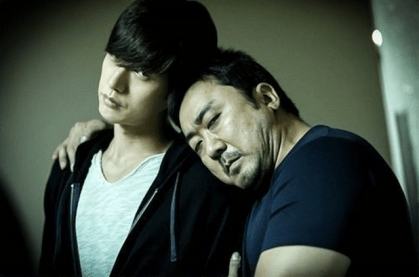
In Bad Guys (2014) he played a deliciously evil character who in many ways had no likable parts to his character, but somehow I felt sympathy for him and no matter how unapproachable he was I ‘liked’ him. This drama is not for everyone as it has it dark parts, but I enjoyed the whole ‘Dirty Dozen‘ vibe. Plus I like Ma Dong Suk.

2016 was the year of the extremely popular Cheese In The Trap followed by Man To Man in 2017. For some reason a lot of people didn’t like Man To Man, but it was one of my favorite dramas of 2017.
2018 was a bit of a mess as he was due to star in Four Men, but it seems that the production of the series was halted part way through and I’m not sure what happened. I haven’t read any particular controversy about this although Park Hae Jin is no stranger to that. He didn’t serve in the military due to ‘depression and sociophobia’ and was official exempt, but netizens have commented that he is faking. There are also rumors of him working at a ‘host bar’ when he was young, but nothing has been proved and to me it doesn’t really matter either way.

On the flip side he is widely known as a philanthropist and has donated not only his time, but also over US $ 1.5 million since his debut. I’ve enjoyed a few of his dramas and have rewatched a couple of them more than once and am looking forward to his future work.
————————————————————————————————————————————-
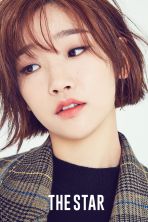
There are also multiple actresses with the surname of Park and I’d probably say that Park So Dam who is cute and engaging and has seen some success with Beautiful Mind and her Cinderella and The Four Knights is worth watching. Also Park Ye Jin has to be a favorite, not necessarily for a specific acting role, but for Family Outing Season 1. As herself she was pretty amazing and I would have her on my team in any end of the world scenario.

A part 2 may follow soon. Who is your favorite Park? Please let me know in the comments below.
Have a great day everyone.
You may also like Hwarang; Flower Boys of Silla, Is it the Kdrama Actor? and The Best Korean Dramas, (So far this year.)
All photo credits to original owners.
Please do not copy or use without permission and accreditation.
Yeon Nalligi: Korean Kite Flying, part 1.

China, Korea, and Japan each have a long history of flying kites and from time to time each one will assert that they invented the kite, however the most likely inventor seems to be China. China had all the ingredients on hand, silk for sail and string, and bamboo for the frame. China also had a relatively more advanced culture than either Korea or Japan at a relatively earlier date. The Chinese claim the first kites were made by 2 philosophers in the 5th century BCE and were shaped like birds. Early kites were not made for fun, they usually had some military or scientific purpose. About 200 BCE Chinese General Han Hsin used a kite to help work out the distance his soldiers would have to tunnel to get past the defenses and into a city he was besieging. And in CE 549 there is a Chinese record of a kite being used to ask for a rescue mission to be sent out to aid troops in trouble. It appears that early kites were used for communications, signaling, and sometimes for military observations; there are accounts of kites being built large enough to carry a man, who could then spy on enemy troops.
The first account of a kite from Korea comes from CE 637 during the first year of Queen Chindoks’ reign in the kingdom of Silla. Two armies were at war and a shooting star fell from the sky, demoralizing the Silla troops who saw it as bad luck. Silla General Kim Yu Sin attached a burning cotton ball (in some accounts burning straw) to a kite and had it fly up into the night sky. The troops saw this and believed that the shooting start returning into the sky equaled all their bad luck going away. Believing in their new luck the Silla troops won the battle. There is also an account of a 14th century General Choe Yong using kites for shooting firearms, but I couldn’t find out how exactly he did that.

Perhaps the most well known use of kites in Korea might be by Admiral Yi Sun Sin, one of Korea’s most famous heroes. During the late 16th century invasions of Korea by Japan, Admiral Yi led his small navy to victory over the very much larger Japanese navy. There were multiple reasons for his victory, one of which was the use of kites to signal orders to his ships, allowing him to direct them during the battles at sea.
It is thought that the first kites were made using silk as the ‘sail’ which made a kite expensive, and only something for the rich, or the military. After some time, however paper began to be used, which made them much cheaper and allowed more people to have access to them. The paper used most was hanji, a very strong Korean paper made from the inner bark of a mulberry tree. Even the Chinese would import Korean hanji paper because it was the best for multiple uses. It is a strong paper that doesn’t tear easily. Early kites in both China and Korean were rectangular. I couldn’t find when the hole in the middle of the traditional Korean kite became popular, but it helps increase stability, especially in strong winds, it also makes it more maneuverable in light winds. Nowadays a medium weight hanji called sunji is usually used by those wanting to make a traditional kite.

Korean kites can come in many shapes and sizes, but the 2 most common are the rectangular shield kite known as Bangpae Yeon with a hole in the middle, and a diamond shaped kite traditionally with 3 tails called a Gaori Yon. Animal shapes as well as other shaped kites can also be seen flying in the skies above Korea. In the 20th century a famous kite maker called No Yu Sang did much to stop the traditional pastime of kite flying from disappearing. He was the president of the Korean Folk Kite Preservation Society and was recognized as a Human Intangible Cultural Asset by the Korean Government.He said that the traditional Korean kite was”simple but capable of demonstrating wonderful feats in the air.” His grandson carries on this craft to this day and sees many of his kites being bought by overseas clients.
Kite flying can still be seen in open spaces like the parks along the Han river in Seoul, and in the countryside and on beaches, but it is not the popular pastime it once was. It still seems to be a good thing to do on a date and it can be enjoyed by people of any age. Unbelievably it is actually quite good exercise and helps people get outside and into nature, thereby reducing stress.
Part 2 will be about my attempt at making my own Korean kite.
Have a great day everyone.
You may also enjoy Hanji: Korean Paper, Archery in Korea, Ssireum: Korean Style Wrestling, and Korea’s Greatest Hero.
Photos were found on Pinterest and are credited to original owners. Please do not copy or use without permission and accreditation.
Seoul City Gates.
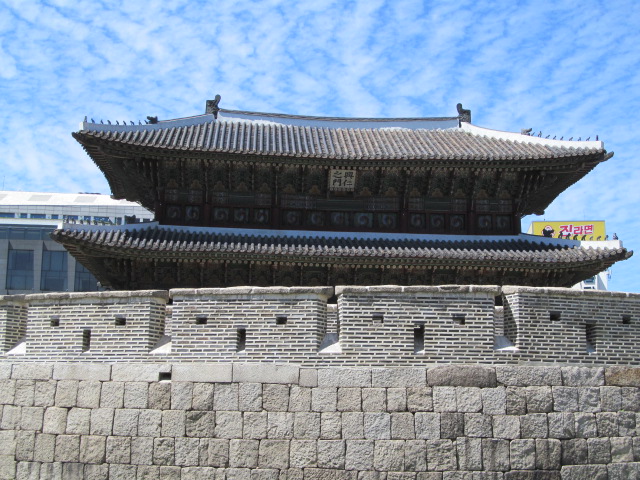
The city of Seoul, once known as Hanyang, became the royal capital during the early years of the Joseon Dynasty. (1392-1897) The city of Hanyang already had some walls and gates, but in order to be a fitting capital city for the new Kingdom much work needed to be done. The plan was to build a wall 18km long, between 4 local mountains, that would have 4 Great Gates and 4 Small Gates.

The building of the city walls and gates took some time because at the time Korea was very much an agricultural society, and you couldn’t take people away from producing food without an adverse effect on food production for the nation. Most building had to take place in the winter when there was less work to do on the farm.
Each of the gates has a name that ties it to its’ location, plus a name that describes its’ attribute, so for example the North Gate, is known as Bukdaemun because of its location, but also as Sukjeongmun which means ‘Rule Solemnly Gate’. This can be a little confusing to visitors so it is best to know both names before you go. There are 4 Great Gates, and 4 Small Gates, 2 gates no longer exist, but possibly may be reconstructed in the future.

The Great Gates. North Gate. Bukdaemun. Sukjeongmun. Rule Solemnly Gate. South Gate. Namdaemun. Sungnyemun. Exalted Ceremonies Gate. East Gate. Dongdaemun. Heunginjimun. Rising Benevolence Gate. West Gate.Seodaemun. Donuimun. Loyalty Gate.

The Small Gates. North West Gate. Jahamun. Changuimun. Showing the Correct Thing Gate. North East Gate, Dongsomun. Hyehwamun. Distribution of Wisdom Gate. South West Gate. Seosomun. Souimun. Promotion of Justice Gate. South East Gate. Namsomun. Gwanghuimun. Bright light Gate.
All the gates were built between 1396 and 1398 and have suffered different fates over the years. One, Jahamun, was partially burned down during the 1590’s Japanese invasions, and then rebuilt in the 1740’s. Some like, Dongdaemun, Dongsomun, and Seosomun were destroyed or torn down by the Japaneses during their colonial rule of Korea. (1910-1945). Namsomun was partially destroyed during the Korean War, and Namdaemun was torched by an arsonist in 2008. Most of the gates have been, or are in the process, of being restored or rebuilt. Only 2 gates no longer exist, Seodaemum and Seosomun, although there is talk of rebuilding one of them starting in 2022.

The two most popular gates to visit are Dongdaemun and Namdaemun, both close to markets, and other tourist attractions, and easy to get to. Both are beautiful and stand proudly in the middle of the thriving modern city. The third still existing Great Gate, Bukdaemun, is harder to visit since you must apply to visit, and carry a passport, as it is so close to the Blue House that there are security concerns.
The city gates help to remind us of old Seoul, ruled by a King, where the gates were closed at night and the citizens slept safely behind the city walls. They are an iconic image of Seoul and appear on stamps, postcards,souvenirs, and in countless movies and dramas. The number one National Treasure of Korea is the Namdaemun Gate.
Have a great day everyone.
You may also enjoy Stone Men of Jeju, Bongeunsa Temple, Korean Salt, Haedong Yonggungsa Temple, and Hanji, the Paper of Korea.
Photo credits to original owners, me, and map and 2nd and last photo to http://www.korea.net Please do not copy or use without permission or accreditation.
The Kings of Kpop.

There are a multitude of good, and even perhaps great, Kpop groups, but no group has dominated the past ten years like BigBang. Officially debuting in 2006 they are in the process of celebrating their 10th anniversary, and are hopefully culminating the year with the release of a completed MADE album. News of them filming 2 new MVs hit the interwebs a couple of days ago and fan anticipation is high.
Many articles, interviews, and documentaries can be seen online and there is no way I could hope to cover all they’ve achieved in the last decade, so here’s a quick run through some of my favorites. The songs and music obviously come first, and one can’t mention BigBang without talking about Fantastic Baby, (2012) This has undeniably become their most iconic, and most successful, song. The song is catchy and fun, with enough English words to make singing along to the ‘hook’ easy even for foreign fans. But there’s a depth and complexity too, that you come to appreciate the more you listen. The MV is weird and wacky, and wonderful, with Korean cultural and popular symbolism hidden among the outlandish costumes and sets. The MV stands at over 254 million views which ranks second only to label mate Psy, for a Korean artist, and ranks first for a Korean Kpop group.

I didn’t really start following Kpop until 2009 so I missed a few of the early years and had to play catch up. I like Goodbye Baby,(2006) even though it is somewhat under-rated, because it shows how some of their early work had a ‘tough hip hop image’ which for the time was not typical Kpop. They look so young, and cute, and innocent, while trying so hard to be tough and edgy. This MV always makes me smile.
2007’s favorite would have to be Lies, written and composed by GD who was 19 at the time. It reached No. 1 on the charts and was named Song of the Year at the Mnet Asian Music Awards. It was not only well received by the public but music critics also praised it, with one even saying that it had “no useless parts”.

Haru, Haru is a song that stands alone as great listening, but the MV adds a poignancy that makes it unforgettable. When you’re having an emotional day it can make you feel all sad and weepy. Poems and song lyrics are among the hardest things to translate perfectly, to not only get the words right, but also the feelings and flow behind the words. Even in English the sadness and love shine through with Haru, Haru.
Tonight came out in 2011 and BigBang traveled to the US to film their MV as their popularity began to really expand outside of Asia. Unfortunately there were ‘incidents’ that occurred, halting plans for a World Tour. But finally a World Tour happened in 2012 to the joy of fans everywhere.
2012 was a phenomenal year for BigBang and it is hard for me to pick the one song that I love the best as they were all good. I think maybe Monster would come a close second to Fantastic Baby, but if you asked me on a different day you probably would get a different answer. The MV for Monster is definitely worth watching for wtf costumes and hair.

2013 and 2014 saw multiple activities, albums, tours, commercials, movies etc for the members, but no group songs were produced. These years proved the depth of talent within BigBang as each member was able to successfully pursue individual career tracks. The fans made do with these activities, but longed for a return of all 5 together again and in 2015 they were rewarded with a string of amazing songs and a World Tour. (I saw them perform in NYC and they were incredible.) My favorite has to be Bang, Bang, Bang, but secretly I think We Like to Party is the song that will always make me feel they are my soulmates. Bang Bang Bang may be the song that finally catches up to Fantastic Baby as it already stands at over 180 million views.
BigBang is not known for doing a lot of variety shows, but they do occasionally appear, as a group, on shows such as Running Man, Happy Together, and The Go Show. They also have appeared as individuals and smaller sub-units on shows such as Infinite Challenge, and Family Outing season 1. Almost any time I see them together on any of these shows I love watching the way they interact with each other. You can see the love, friendship and esteem they have for each other. Much as I love their songs, music, and MVs some of my favorite moments are when I see them laughing and joking around together.
Like most VVIP’s, as BigBang fans are called, I’m eagerly awaiting their 2 new songs, and hoping for more. Military Service looms and although we love them all individually we are happiest when they are all together.
Long Live the Kings.
Have a great day everyone.
You may also enjoy BigBang10 The Exhibition A to Z
Photo credits to original owners. Please do not copy or use without permission and accreditation..
Haedong Yonggungsa Temple: In Photos.

The Korean Dragon Palace Temple, which is more commonly called Haedong Yonggungsa Temple is known as being one of the most striking Buddhist temples in Korea. Much of this may have to do with its amazing location on the edge of the coastline of the East Sea. It is particularly beautiful when the first rays of the rising sun bring the amazing colors of all the paintwork to vibrant life. It is still, however, beautiful at any time you might chance to visit.


It was first built in 1376 by a Buddhist teacher known as Naong who was a consultant to King Gongmin during the Goryeo Dynasty.It was known as Bomun Temple at that time. Unfortunately parts of it were destroyed by fire during the Japanese invasions of the 16th century. Some reconstruction was begun in the 1930’s, but the Main sanctuary wasn’t built/reconstructed until the 1970’s. The reconstructions were carried out with much care using traditional colors and design.


The 108 steps down symbolize the 108 agonies and earthly desires of Buddhism. They also may prove difficult for those in poor health. Coming back up them made me wish I had exercised more.


The temple motto states that “at least one of your wishes will be answered here through your heartfelt prayer,” and along with the tourists you will see many people who have come here to pray.


The temple is situated at a place of great harmony between the sea, the dragon, and the Great Goddess Buddha of mercy, known as Gwanseumbosal in Korean, She is said to live a solitary life next to the sea and appears on the back of a dragon.


Although on the far NE side of Busan it is possible to get there using the metro and then a bus. Most tour companies include a visit on their tours of Busan, so to avoid the crowds get there early. Daybreak is a perfect time to view the temple although many of the entry area vendors might not be open until your return. We had some really tasty freshly made street food type snacks and sweets, but I was too busy eating to take photos.


You may also enjoy Bongeunsa Temple, The Stone Men of Jeju Island, and Spirit Garden.
Have a great day everyone.
Photo credits to me. Please do not copy or use without permission and accreditation.
 KPOP Jacket Lady