KPOP Jacket Lady
KDrama and KPOP Concert Reviews, Travel Tips, Korean Recipes and more
Neolttwigi: A Korean Seesaw Game.

Neolttwigi is a traditional Korean pastime for women and girls that usually happens around the holidays and during the winter months. It is often called a Korean seesaw, but it differs from the usual playground version in that the fulcrum, or pivot point, is not attached and that it is played standing up. The fulcrum used to be a rolled up straw mat, or even a pile of dirt, although nowadays a sturdy wooden block is often used. The plank of wood could be varying lengths, but usually was between 2 and 2.4 meters. To aid in stabilizing the plank sometimes someone would sit on the fulcrum as seen in the image above.
It is not really known when women started playing Neolttwigi, although a famous scholar Yu Deuk Gong (1749-1807) noted in his book Customs of the Capital that “envoys from the Ryukyu Islands learned about this pastime when they came to pay tribute to early Joseon Kings” and that they then took the custom home with them. Ryukyuan envoys are recorded as paying tribute from the late Goryeo period up until the late 16th century. Also there is a popular belief that Neolttwigi was played during the Goryeo period to improve women’s health. With these two clues it seems likely that Neolttwigi has been around at least 600 years and probably more.

Neolttwigi is actually not easy to play as the balancing on the plank and jumping is quite tricky and somewhat strenuous, plus if you take into account that usually the players are dressed in their best hanboks you may wonder why it has such a long history as a pastime. This is said to be because the houses of the yangban or nobles had walls around their houses and women were often not allowed to go outside the walls. This meant that they had very little idea of what was going on beyond the walls of their confinement. Once they discovered Neolttwigi it was a perfect way to catch tiny glimpses of what was going on just beyond their walls. The game could be set up in any open space and required very little equipment or set up time which made it even better. Women, however, weren’t able to use it all the time as their usual daily routines often didn’t allow them much free time, so the game became popular on holidays and during the winter when there wasn’t as much to do.
Women dressed up, and wore their jewelry and makeup, to play because if they jumped high enough to look out, that also meant that anyone outside the walls could look and see them There are a few pastoral poems that describe women jumping high enough for suitors to see them and perhaps to fall in love with them. To jump high you have to be quite athletic, have good balance and have a good partner on the other end of the plank. Women would use a sash to tie their hanboks hitched up to make tripping less likely, and would wear jewelry that would catch the eye and make jingling sounds. Neolttwigi was often a group game with women singing songs and exchanging turns while no doubt gossiping about all they had seen beyond the walls.
“A woman with a purple skirt steps out. Her feet are exposed. I glance and see a maiden with slicked back hair. Hers is a radiant face. I’m in ecstasy just looking at the women at play, so who is to blame?” From a poem by Nakha Yi Hakgyu. I wonder if the women knew how the men watching felt, since this is not the only poem extolling the attractiveness of women playing Neolttwigi.

As time passed women also began to do tricks, such as lifting a leg while in the air or turning around, and this developed into acrobatic performances. Nowadays Neolttwigi is pretty much relegated to Folk Museums and Villages, although it does sometimes appear in Sageuk, and at the bigger Folk Festivals. I’ve never tried it, but perhaps one day I’ll be able to.
You may also like Ssireum, Geune Ttwigi, Tuho, and Paengi.
Have a great day everyone.
Photo credits to original owners. 1st photo in public domain. 2nd photo: http://www.korea.net/NewsFocus/Culture/view?articleId=85017 3rd photo: stock image. last photo: http://www.koreatimes.co.kr/www/common/printpreview.asp?categoryCode=115&newsIdx=88291
Please do not copy or use without permission and accreditation.
Seoul Bamdokkaebi Night Markets.
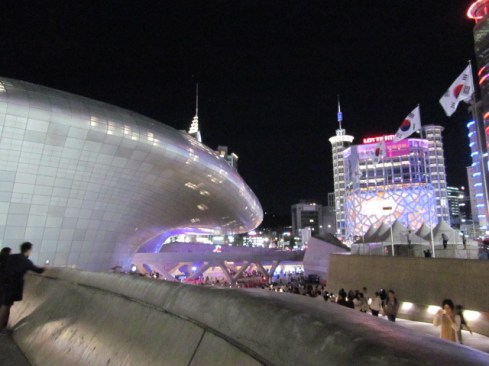
Seoul is a city that never seems to sleep, maybe because there’s just so much to do at night including shopping. Most people have heard of the Dongdaemun Open Market which doesn’t even open until 10pm and stays open until 5am, but Seoul also has some seasonal night markets, including one at Dongdaemun Design Plaza, that are perfect for those who want a fun night out. The Bamdokkaebi Night Markets are only open on Friday and Saturday nights from late March until late October.
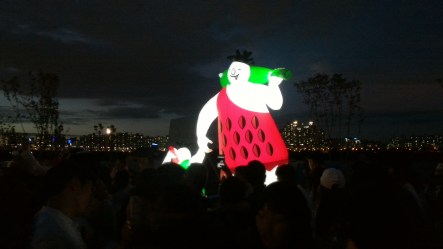
They are called Bamdokkaebi after a Korean folk figure. Bam means ‘night’ while a dokkaebi is an ogre, demon, giant type mythic figure who can be frightening, or in this case humorous and friendly. So Bamdokkaebi is a friendly giant who only comes out at night and disappears during the day, just like these markets. The dokkaebi carry a club that is somewhat like a magic wand and they help out good people while tricking and punishing the bad.

There are 4 Bamdokkaebi Night Markets each with a different theme or concept. There’s the World Market at Yeouido Hangang Park which overlooks the Han River, the Youth Runway and Dance Night at the beautiful Dongdaemun Design Plaza, the Sports and Health one at Mokdong Stadium, and lastly the Seasonal/Holiday Market at Cheonggye Plaza which has limited opening dates. (Please check times and dates for all of them before you go as they vary slightly for each venue.)

We only managed to visit two of the four, Yeouido and Dongdaemun, and thoroughly enjoyed both of them. The World Market at Yeouido was absolutely heaving with people who were enjoying everything the market had to offer. The lines at the 30 or so food trucks were long, but since there was a lovely cool breeze off the river and the city lights sparkled in the distance, most people didn’t seem to mind the wait for food from different places around the world. The handmade craft booths were interesting although not particularly world representative. There were busker like performances as well as a stage set in the Han river. Families and couples were sat on the banks on the river relaxing and enjoying a pleasant evening outside, whilst groups of friends could be seen chatting and laughing with each other. There were a few tourists, but the crowd was mostly made up of locals out for fun on a Saturday night. It was a perfect place to be part of the experience instead of an outsider watching from the sidelines.


The Market at the Dongdaemun Design Plaza was extra special, mostly because of the setting. Although originally there was some controversy over the design when it was first built, the Dongdaemun Design Plaza really is a spectacular piece of architecture, especially at night, when different panels light up and glow. It is a free flowing large scale work of art, and having courtyards and hidden nooks made it a perfect place to hold an event such as this. There were performances on the main outdoor stage as well as musicians and buskers hidden around the curves and contours of the building. The craft booths had a variety of items for sale that were geared more towards the young and fashion conscious. The Meokgeori, or Food Truck Street, was extremely busy, this time because the focus was on young, innovative styles of food. Cutting edge chefs and fusion style foods were on offer from a multitude of food trucks. (I too see the irony in my photo showing a hot dog stand, but I was too busy having a great time to take appropriate photos!)

All in all we enjoyed both night markets and they were perfect for a stop on a typical weekend night out in Seoul, which usually involves multiple ’rounds’ at different places and not ending until the wee hours of the morning long after the subway stops running. Just as well taxis are cheap in Seoul!
Have a great day everyone.
Photo credits to me, Elle Marzec and our friend Hye Rin. Please do not copy or use without permission and accreditation.
A Walk Down KStar Road.

Like most Kpop fans we had to make a quick trip to Gangnam while on our recent trip to Korea. Not only is it famous because of Psy’s song, but it is also because it has numerous entertainment companies, plus multiple restaurants and cafes owned by Kpop idols and/or their families. While the chances of seeing your favorite idol are low it is always worth a visit to see if it is your lucky day.


We decided to start by checking out Kstar road, an area designated by the city government to help advertise the Hallyu wave and to cater to Kpop fans by placing ‘dols’ of some famous idol groups along one side of what was once called the ‘luxury street of Cheongdam’. It was low key fun strolling the tree lined street looking for my favorites. I posed with 17 of them, even though I felt like a bit of a dork. The locals, however, are quite used to seeing the fans being silly and barely gave us a second glance.


The ‘road’ starts at Apgujeong Rodeo station exit 2 and ends at the Cheongdam Crossroads. It is about 1 km long and to see all of the ‘dols’ and take photos takes quite a while. The street is lined with high end shops, office buildings, restaurants, etc but the main focus for Kpop fans are the ‘dols’.


There is a Gangnamdol Haus in front of exit 7 of Apgujeong Rodeo Station where you can mini-dols as souvenirs, but we didn’t stop in because I knew I’d be tempted to buy them all. Instead I just took photos with the life sized ones.


The Cheongdam/Gangnam area has lots of things for Kpop fans to see and do and Kstar road is just a small part of what the area has to offer. Keep your eyes open for future posts and have a great day.
You may also be interested in a review of where we had lunch while in the area.
Photo credits to Elle Marzec. Please do not copy without permission or accreditation.
SAUCE Tonkatsu Restaurant Gangnam: Review.
I read quite a few restaurant reviews and am always impressed and envious of how the authors manage to describe the flavors and tastes to such a degree that it makes me wonder if they all truly have that sensitive of a palate. I appreciate good food, good service, and a good atmosphere. Cleanliness, cost, and location are also important, and so I do applaud the efforts involved in finding that perfect meal, in that perfect place and then sharing it with us. But don’t expect that from me. I tend to review the places that a regular person would go and as such the basic criteria is would I look forward to eating there again.
While visiting Gangnam a few weeks ago there was no shortage of choices of places to eat, from high end fancy restaurants to those owned by celebrities, or their close family members. You could eat at a different restaurant twice a day for months without running out of choices. (Seriously, Seoul has more restaurants per person than almost anywhere on earth, and Gangnam has a good proportion of said restaurants.) So why am I recommending this particularly restaurant tucked just off the main drag when there are so many amazing choices available? For a few reasons including the wide variety of customers. There were a couple of delivery men sat in a corner, a group of well dressed company workers, a few middle aged people, a very smartly dressed lady, a couple of suits, some teens, and us as the only non Koreans. Most tables were occupied even though we arrived a little past lunch time. Everyone else seemed local and familiar with the place which is always a good sign. The service was quick and even though the staff spoke very little English the ordering went smoothly. The atmosphere was nice, the decorations quirky, and it had a nice relaxed feel. The building itself was a little older than the surrounding ones and it looked like it had once been someone’s home. The prices were extremely reasonable, especially considering it was in Gangnam, with my meal being under ten dollars.
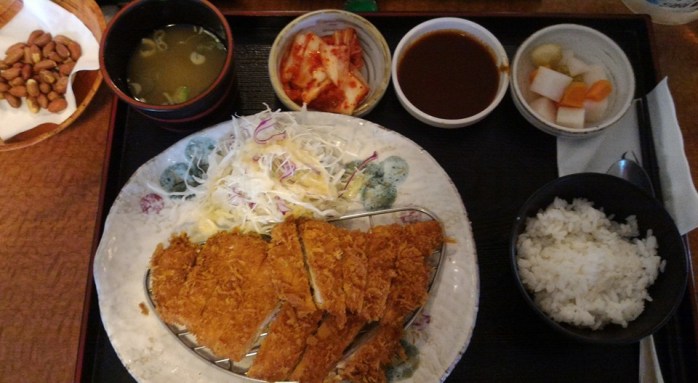
I ordered the plain tonkatsu and my daughter the cheese one, and both were excellent, served piping hot with a wonderful crisp batter on the outside and moist succulent pork on the inside. As is usual it came with a number of sides, as well as a really light and refreshing shredded vegetable salad. I ate every last bite, which means it really was good as I’m kinda skinny without that large of an appetite.
You may ask why we went to a tonkatsu, which is originally a Japanese dish, restaurant while in Korea, and the answer is the same as why does Korea have so many coffee places and Italian restaurants. Korea has a wonderful knack of taking good food from around the world and somehow making it their own, and often making it better. Tonkatsu is a very popular dish in Korea and has become a regular choice for many.
And to answer the big question. Would I eat there again? Yes I would, it was a delicious meal, in a nice place, for a decent price. What more can you ask for?
The address is 62-14, Cheongdam-1dong, Gangnam-gu, Seoul-si, 135-948, Korea. It is one building back from the main KStar road down a small side street between a Banyan Tree Club and Spa (not the main one which is near Namsan) and a shop called Tehome.
Have a great day everyone.
Photo credits me and Elle Marzec. Please do not copy or repost without permission and accreditation.
Paengi: Korean Spinning Tops.

Spinning tops were once popular all over the world and have a very long history. No one knows when or where the first ‘top’ was spun, but we do know that the ancient Egyptians spun tops. One hypothesis as to their invention is based on the similarity of a top to a spinning tool called a drop spindle. It suggests that a broken spindle with a short handle was picked up by someone and that when twirled between the thumb and index finger, a movement similar to the action used when spinning wool, it spun in a pleasing manner and a new toy was invented. This seems a likely scenario, although some cultures made their ‘tops’ from sea shells or nuts so perhaps spinning tops were independently invented in different places at different times.

The oldest top found in Asia was found in Shanxi Province in China and is said to be about 4,000 years old, putting it on par with the ones found in ancient Egypt.The first known reference to spinning tops in Korea is found in a Japanese book from AD 720 which says that tops came to Japan from Goryeo. It is therefore quite likely that tops were played in Korea for some time before this date. Later references come from AD 1690 and 1779, proving the continued popularity of the activity. Spinning tops could be played by whipping the top with a whipcord once it had begun to spin, with the winner being the one that either spun their top the longest or managed to knock any opposing tops over. This game was often played on ice in the winter as the ice provided a nice smooth surface for the spinning top.
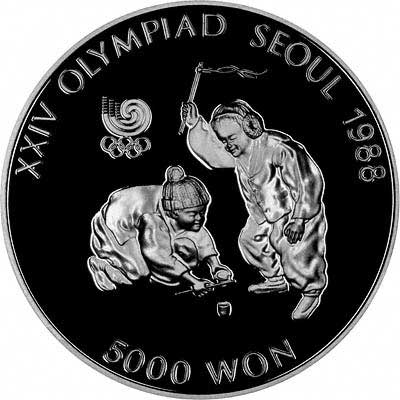
Other ways to play with tops included ‘fighting’ by throwing your spinning tops into an enclosed box, or area, where the goal was to knock down your opponents tops. You could also play by having obstacles in the box that your top had to knock down for points. Performing tricks with spinning tops was also a popular activity. The 2 main ways of spinning tops was with the thumb and index finger or by using a string wound around the top and then pulled.
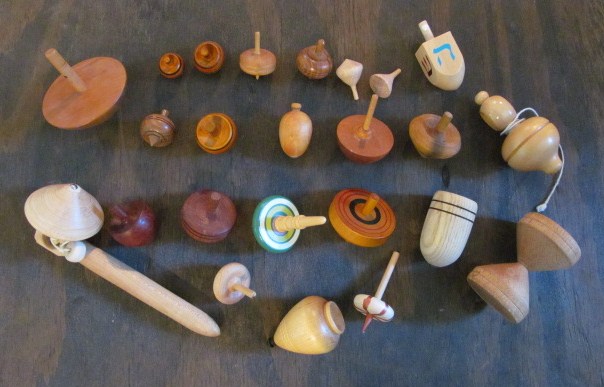
Tops come in many shapes and sizes and can be made from various materials, however the best tops are made from good quality hardwoods. Fighting tops in particular should be made of dense, hard wood. Many modern wooden tops are unfortunately made from relatively soft cheaper wood. The game of spinning tops is dying out as an activity in many places and many times you can only see them played in folk villages, museums, or as a curiosity. Fortunately recent years have seen somewhat of a comeback in some places, and in places like China, Taiwan, and Japan they have always been popular with many skilled players and competitions still to be found.
Usually played in Korea in the winter time, and on holidays, it is still possible to occasionally see people playing with spinning tops in Korea. We saw some students recently in Insadong encouraging the crowds to try out traditional Korean games. You can also buy them in some markets and from street vendors.
Although not very good at using the whipcord to spin tops I do find it lots of fun and worth more than a few laughs. You may find it easier to buy good quality traditional wooden tops where you live and if so feel free to share a comment or photo in the comments below.
Have a good day everyone.
You may also enjoy alkeggi, gonggi, kai-bai-bo, jegi chagi, ssireum, ddakji, tuho, and yut.
Photo credits me and Elle Marzec, except for coin photo which is public domain. Please do not copy or use without permission and accreditation.
Korean Tea.
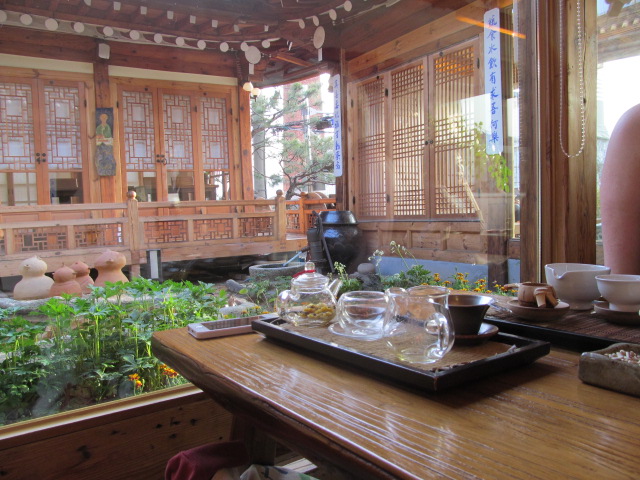
Tea is technically made from the leaves of the camellia sinensis tree, but around the world the designation ‘tea’ often encompasses so much more. In Korea the word for tea, ‘cha’ can mean an infusion of almost anything, including the leaves of the camellia sinensis. There are Korean teas made from roots, fruits, leaves, grains, pollen, tree bark, honey, nuts, and even dried fungus. Korean tea can be served hot or cold, or even somewhere in between.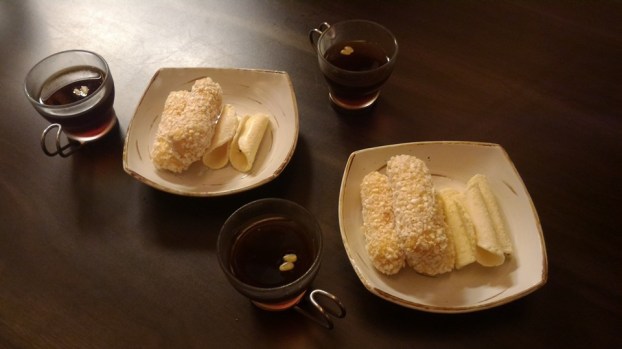
Green tea has been drunk in Korea for centuries, with the first written record of its use during religious rites being from 661 AD. Most people agree that tea drinking probably originated in China where it was first used, mixed with other ingredients, as a medicinal drink. The drinking of tea in this manner may date back over 3,000 years, although it was a long time before it became a stand alone drink. Han Dynasty emperors were said to have drunk tea and the first definitive written account is from the 3rd century AD. One of the earlier methods of making tea was by steaming the leaves, others ways included roasting the leaves and then crumbling them, pan frying then rolling and drying them, and by letting the leaves ferment over time before pressing the tea into molds. Black, green, and fermented tea could all be pressed into molds to become solid ‘bricks’ which were easier to transport and store than tea leaves. These bricks of tea were sometimes used as currency. By the 14th century loose leaf tea became popular.
With the close geographic proximity and the intertwining of Korea’s history with that of China, it seems probable that the Korean elite had earlier access to tea than the common people. Whether it was a drink that was drunk frequently, or whether it was reserved solely for medicinal use and ancestral rites is open to debate. It seems that the drinking of green tea had periods of popularity followed by times of little usage. This may be because although Korea does have a kind of native tea known as Paeksan-cha, and green tea farms existed on a small scale, most tea was imported up until the 1960’s when the first commercial production of green tea began. Nowadays the three main tea producing areas in Korea are Bosung County, Hadong County, and Jeju Province.
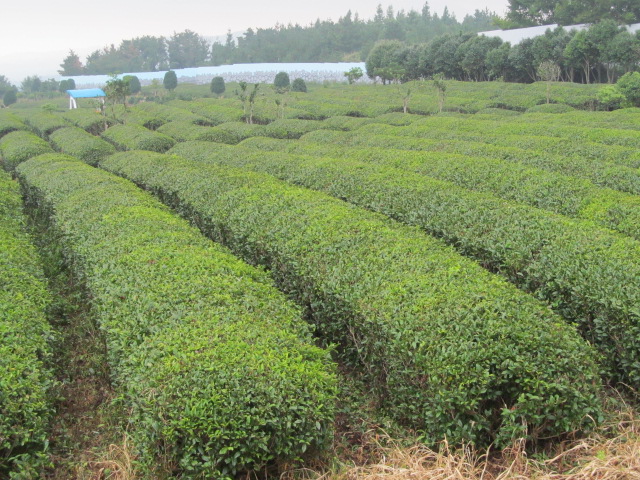
O’sulloc is probably the most famous and popular green tea available in Korea. It is grown on Jeju Island, where conditions are perfect for the growing of tea. Other tea farms on Jeju also welcome visitors and we enjoyed a pleasant visit to Green Tea Maze Park, where we sat out a sudden squall in a tea house overlooking the tea plantation. We not only drank some lovely tea, but also had the most amazing green tea waffles and ice cream.

Numerous companies, and individuals are trying to restore and revive Korea’s traditional tea history and culture, which had almost faded completely away. Korea’s ceremonial tea culture deserves to be preserved, even in the face of most modern Koreans preference for coffee.
Non camellia sinensis teas, which might perhaps be called tisanes and infusions by non Koreans, have always held a special place in Korean culture and many people still drink these forms of tea. They are often said to have health benefits and some are drunk for specific illnesses or just as pick me up tonics to increase energy and wellbeing.

Teas made from roots include Insam cha (ginseng), Saenggang cha (ginger), and Chik cha (kudzu). While fruit teas include Yujacha (citron), and Daechucha (jejubes). Teas such as Taengja cha and Maeshil cha are made from fermented fruit whilst Bori cha (roasted barley), and Hyeonmi cha (roasted rice) are made from seeds or grains. Cha can also be made from leaves, dried fungus, pollen, tree bark and other things that over the centuries the Korean people have discovered to be safe and beneficial to drink. Many of these teas are really unique and are worth trying if you get the opportunity.
Let me know your favorite Korean tea and have a great day everyone.
You may also enjoy Green Tea Waffles.
Photo credits me and Elle Marzec. Please do not copy without permission and accreditation.
Deconstructing the Kpop Jacket.


As some of you know the kpopjacket began almost by accident, there was no plan or goal at the beginning and it just grew and developed as time passed. Unfortunately the ‘kpop’ has become larger than the jacket and there’s no space left to add new patches to it. It was suggested I start a new jacket and keep this one as is, but since I wear my jacket to concerts and events and I can only wear one jacket at a time I decided to get a new larger jacket, and move all the patches over to a new one.
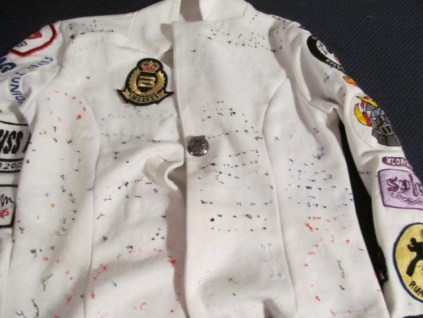
Removing the patches is harder than I thought it would be, both sewing wise and emotionally. It is hard to deconstruct something which took so much time to make. As I remove the patches I’m not only realizing just how many patches I actually hand embroidered, but also how many memories are tied up in them.

I’ll work on taking the patches off the sleeves tonight, and then I need to iron them all before starting on the daunting task of sewing them onto the new jacket. The new jacket is larger, and lighter weight, which will be good in the Texas heat, but I have a slight worry it won’t hang well. The original jacket did a great job of showcasing all the patches.
edit. all the patches, except the one that was ironed onto the jacket, removed.


The beginning of jacket version 2.0
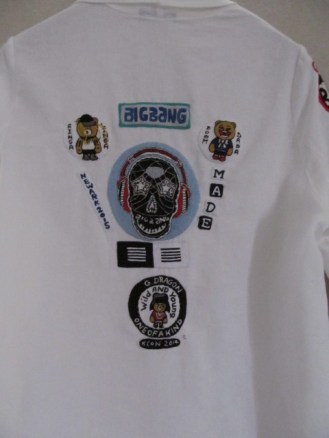
Wish me luck, and the new jacket and I hope to meet all of you in the future.
You may also like the post about the original jacket.
Edited, Oct.13th 2016. Most of the patches are on the new jacket now, just a handful more to add and then I can start catching up on making patches for the groups I’ve missed.


Have a great day everyone.
Photo credits to me. Please do not copy or repost without permission and accreditation.
The Stone Men of Jeju Island.


The Dol Hareubang, or stone grandfathers, are perhaps the most recognised symbol of Korea’s Jeju Island. We’ve seen them on Kdramas, variety shows, advertising campaigns, and stamps.

Although they look like they’ve been around forever, it is thought that they originated in the mid 1700’s and were perhaps influenced by South Pacific stone statues such as those from Easter Island. Other theories place them as having been influenced by the Turkic Kurgan stelae of Mongolia, or that they were an original Korean invention. Since other anthropomorphic statues appear in cultures all around the world I’m ok believing them to be totally Korean. There are similarities between the Dol Hareubang of Jeju Island and the mainland Korea stone jangseung, but with the stone jangseung not having any hands. (Many jangseung are made from timber and bear a slight resemblance to totem poles.)


There are only about 47 original Dol Hareubang, with the rest being of modern origin. You can now find them in every possible size, as well as in forms such as sweet treats to tempt tourists.
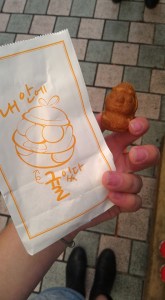
The Dol Hareubang are seen as protectors or guardians and may have originally stood guard at gateways and entrances to fortresses and other important buildings.They were usually found in pairs which lends credence to them being gate guardians. With their slightly mushroom shaped soldiers hats they are also seen as a fertility symbols, with women rubbing the noses for a boy baby and the ears for a girl. Dol Hareubang was originally a nickname for them, but it became their official name in 1971.

But the Dol Hareubang are not the only stone men of Jeju Island. We found lots of volcanic basalt rock that looked vaguely human that had been collected and put in gardens and along forest trails. Some of these little men were left in the natural state whilst some had had minimal carving to create human features.


They were cute, but scary at the same time, giving you that being watched feeling that raises the hair on the back of your neck.
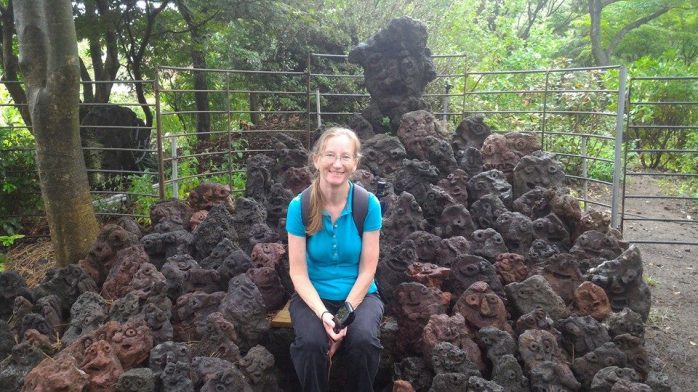
In some ways I prefered these little stone men as they had a lot of character and charm. Some were even in the form of animals like these Jeju pigs.


We discovered that there were also large stone men more in keeping with the Inuksuk of the Inuit.
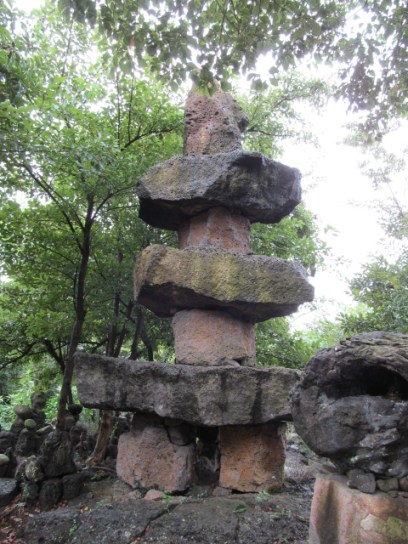
And lastly there were the stone men of the Buddhist Temples.


Jeju Island is a wonderful place to visit with lots of unique things to see and do. Some of our best memories, however, came from some of the lesser attractions such as all the different ‘stone men of Jeju’.
Have a great day everyone.
You may also like Spirit Garden.
Photo credits to me and Elle Marzec, except for stamp image which was in public domain. Please do not copy without permission or accreditation.
Green Tea Waffles.


Korea could be described as the land of cafes, and the coffee culture is as intense and prolific as anywhere else in the world. I am quite sure there are more cafes per person in Seoul than anywhere else on earth. The choices of things to eat with your coffee, tea, or fruit ade are varied, but some things are so good you’ll come across versions of them fairly often. Green tea waffles were among my favorite tea time treats.
Now that I’m back home from my most recent trip I thought I’d see if I could come anywhere close to recreating those I enjoyed just a few short days ago.
I thought my biggest problem might be finding the green tea ice cream, but fortunately Haagen Dazs saved the day. I was also fortunate that I brought some green tea honey home with me. I cheated and used a pancake/waffle mix, but next time will make the waffles from scratch.


Instead of plain water I used cold green tea, although next time I’ll probably try matcha powder for a more intense color and flavor. Make your waffles and then put them on a nice plate, add green tea ice cream and vanilla ice cream to the plate, along with honey, syrup, whipped cream, and maybe fruit.


In Korea we basically cut the waffles into bite sized pieces and added as many toppings as could fit. At home I was lazy and piled everything on top, mushed it down and ate it. It wasn’t as good as in Korea, but it was still gosh darned tasty. I recommend it for a lazy Sunday type brunch, or anytime really.
Have a great day everyone.
Photo credits me and Elle Marzec. Please do not use without permission and accreditation.
Spirit Garden.
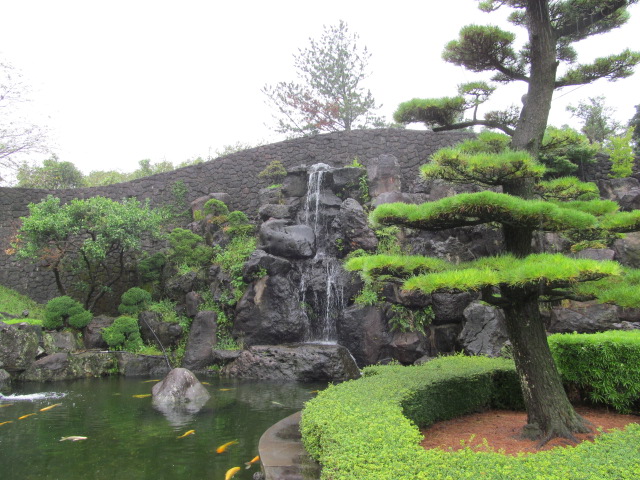
On Korea’s Jeju Island there’s a small garden devoted to the ancient art of bunjae, known in the west by the Japanese name of bonsai. The garden began in 1963 when Seong Beomyeong bought a piece of wasteland and began the process of converting it into one of the world’s top gardens. The garden was opened in 1992 under the name Bunjae Arpia and then later it became Spirit, or Spirited Garden.


It was raining during our visit which may have been a good thing as it meant there were fewer visitors to disturb the peace of the garden. There were informational signs throughout the garden in both Korean and English and it was worthwhile to stop and read them, although it should be noted that these are the personal opinions of the gardener.


Doing a little background research shows that the Chinese developed the art of penjing, creating miniature scenes in trays to include trees and plants, probably around 2,000 years ago, although definitive proof shows up in 706AD with a Chinese illustration showing the practice. Legends and descriptions mention the practice as being in place in China from a very early date.


China and Korea have a very long history of interacting with each other and the art of penjing made its way to Korea where it took hold and flourished. It arrived in Japan at a later date, spread either by Buddhist monks or Chinese ambassadors. In each country the style changed over time to suit the preferences of that country. Some people consider Japanese bonsai to be superior, however, penjing more closely follows the ancient and traditional methods and aesthetics, while bunjae has a charm of its own. Ironically during the Japanese Colonial occupation of Korea many of Korea’s best bunjae were taken to Japan, meaning that some of the older and more revered bonsai may have had a Korean beginning.
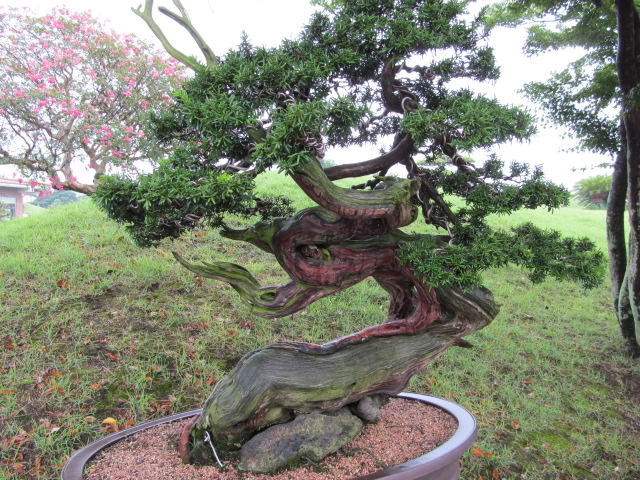
If you enjoy trees and want to explore the world of training and miniaturizing trees to bring out their hidden beauty this is definitely the garden to visit. It is not a showy garden, but is subtle and understated with a charm that slowly insinuates itself into your being. You can sense the age and strength within the trees. With care bunjae/bonsai trees can live to a great age and are highly sought over as status symbols. This collection is worth a small fortune.


To finish our visit we bought some fish food and had fun feeding the koi.


Have a great day everyone.
 KPOP Jacket Lady