KPOP Jacket Lady
KDrama and KPOP Concert Reviews, Travel Tips, Korean Recipes and more
Recipe: Soy Glazed Edamame.
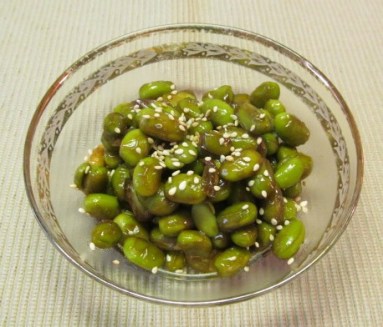
This is a really quick and easy recipe that is perfect for when you don’t have enough banchan or namul for your Korean meal. I used half of a bag of frozen edamame that needed to be used up. I added some water to a microwaveable covered bowl and microwaved them for 2 minutes, then I let them sit for a few minutes before stirring and microwaving for 3 more minutes. You can also use the frozen ones that steam in the package, just follow package directions for cooking. The rest of the ingredients are 1/4 cup of my make ahead soy cooking sauce, and 2 tbsp sherry. You can add 1/2 tsp red pepper flakes to make it more spicy, but I omitted them this time as I plan to serve this with a spicy pork recipe and don’t want too much spicy in one meal. The sesame oil is used to coat the pan and the sesame seeds are for decoration.


Mix the soy cooking sauce and the sherry together and stir in the edamame. Let sit while you add a little sesame oil to a frying or saute pan. When pan and oil are hot add the edamame to the pan. Cook on medium high heat until the liquid forms a glaze on the edamame. You will need to keep an eye on the pan and stir as necessary to coat all the edamame evenly. When done pour into serving bowl/s. This can be eaten warm or cold, and also makes a great healthy snack.


This is one of those recipes that you can easily make to your own taste by adding ingredients such as very finely minced garlic, or ginger, and of course the spice level can be toned up or down depending on your preferences.
Have a great day everyone.
Kpop Musings.
Late yesterday evening I thought that, since the year was half over, I would write something about a couple of the new (2016) rookie groups that I consider to have the potential and backing to succeed in the tough world of Kpop. As I began to jot down some notes I realized that without talking a little bit about Kpop as an entity some of what I wrote would be meaningless to some readers so here is some background information.
Kpop is a business, a huge, lightly regulated business that is becoming more and more saturated with both entertainment agencies and Kpop groups. To be able to succeed talent is only one of the requirements, it is no longer just enough to be able to sing, dance, and look good. You also have to be physically fit, determined, and be able to put up with sometimes harsh and rigorous training and exhaustive event schedules. Agencies also like it if you can speak a second language, play an instrument, write lyrics, or compose music. You might well have to subsume your natural character and fit the image the agency has determined for you, plus you will be expected to be good at ‘fan service’ and have no romantic life in case it upsets your fans. If you are naturally funny or have some other ‘talent’ that makes you stand out from the crowd so much the better. Even if you are incredibly good looking, talented and have all the attributes listed above you still need the backing and support of a reputable agency, and a lot of luck.
The Kpop business had, and has, good and bad guys. Originally Kpop agencies were largely unregulated and young wannabe idols were taken advantage of by said agencies who persuaded them to sign unfair contracts. Many trainees received little to no compensation during their trainee years and often lived in agency dorms sleeping 4 or more to a room. Then once they finally debuted the agency would deduct ‘expenses’ for all those trainee years. So some Kpop groups would not, and still often do not, receive a living wage for years after their debut. In 2013 the Wall Street Journal reported that SM Entertainment spent about 3 million US dollars to ‘rear’ a single idol, and that they expected that to be paid back.
Times have changed somewhat since the TVXQ lawsuit against SM which led to the Korean Fair Trade Commission stepping in with templates for future contracts. A law of 2014 does attempt to regulate working conditions and the overt sexualization of underage idols, but one only has to look at current music videos to see that isn’t really working out too well.
Which agency you sign with can make the difference between success or failure. If chosen to debut with one of the ‘big 3’, being SM Entertainment, JPY Entertainment, (although there are fears JPY might fall out of the top three within the next year or two) or YG Entertainment, then the chances of success are higher, not only because of the training, but also because of their power within the entertainment business. They have the contacts, the knowhow, the pool of talented producers, choreographers, sound technicians, stylists etc from which to draw in order to produce the best product. (Training with such a company does not, however, always equal success as trainees are often let go if they aren’t seen as being a good enough investment. Dismissed trainees do sometimes get picked up by other, smaller, agencies, while others just fade away and disappear from the music scene completely. Life is tough in this business.) Remember too that this really is a business and that idols are in many ways seen as commodities.
There quite a few midsize agencies who focus on fewer groups who are doing quite well, noticeably FNC Entertainment, Starship Entertainment, and Plan A Entertainment. There are also entertainment companies who are relying on one group to carry the load until new rookie groups from within those agencies can successfully debut. And then there’s the fly by night agencies who basically con wannabe idols into signing with them with lofty promises which they are unable to keep. More than one idol group has made their debut with one of these agencies to find that unless their first release is a success there will never be a second one. This is a shame as some good talent has been lost to Kpop this way.
Entertainment agencies not only have Kpop artists under contract, they also have actors, comedians, models, and celebrities under their umbrella, so not all revenue come from Kpop. A top Kpop group, however, can bring in a lot of money. Big Bang from YG Entertainment is ranked 54th on the Forbes list of highest paid celebrities in the world, with earnings of 44 million US dollar for the period June 2015 to June 2016. That’s more than Katy Perry, Robert Downey Junior or Elton John. They didn’t just earn this money from music, they also appeared in commercials, print advertising, and at fan meeting etc. At least two members are also actors, and group leader G.Dragon has his fingers in the worlds of fashion, beauty, and design. He also writes and produces songs. Many idols work extremely hard for their money and fame.
Most contracts within the Kpop business allow artists to keep a larger percentage of their overseas and non musical earnings, which is why you see so many Kpop groups performing and working in Japan, which is of course the second largest music market in the world. China is also becoming a popular place to earn extra money. Fan meets in particular are good money makers, being easier to set up than a concert, and bringing in almost as much revenue.
Kpop has a huge following in Asia, and it is gradually spreading around the world. Concerts have been held on every continent except Africa and Antarctica, and with the advent of social media Kpop can be seen and heard on YouTube, and other sites, wherever you might live. Foreign fans are increasing in numbers as the phenomenon spreads around the globe. In 2012 Time magazine said Kpop was “South Korea’s biggest export,” and in 2014 the Economist said that the Kpop culture was”Asia’s foremost trendsetter.” It has become such that without a continually growing international fan base, along with its interest and support, many Kpop groups would cease to exist. The Korean market alone is no longer big enough to support the Kpop industry of today. This is true because whilst popular in Korea, Kpop is not the only genre of music Koreans listen to. Korean’s like to listen to an eclectic range of music from Trot, to traditional, and western styles of music.
Many people have a hard time understanding the allure of Kpop and see it as being unoriginal and lacking in authenticity. Others see it as being all style without substance with an emphasis on the visual, perhaps at the expense of the musical. These things may have some basis in truth if you are talking about Kpop in general; there are groups who don’t have much musical ability or dancing skills, but the same can be said for any genre of music. If you like rock music can you honestly tell me that every rock group is good, of course not, and so it also holds true for Kpop.
Kpop has some incredible singers, dancers, music, and choreography. There’s sweet songs of perfect love, and heart wrenching songs of that love being lost. There’s brash boys showcasing their swag, and beautiful girls hinting at promises, that due to censorship rules can’t be said. There’s songs that lean towards hip-hop, and others that have the hard edge of rock, or the smoothness of R&B. Kpop is varied and groups are beginning to strive to stand out from the crowd. If you look at Big Bang singing Fantastic Baby or Bang Bang Bang you would hardly classify them as belonging to the same genre as Crayon Pop performing Bar Bar Bar. Yes, the middle ground of Kpop has many groups who on the surface may look very similar, with the same clean cut wholesome appearance, pleasant songs and bright and cheerful outfits, but delve a little deeper and I bet even these groups have one or more harder hitting songs up their sleeves.
In some ways Kpop is seasonal and many Kpop groups strive to be the one with the hit summer song of the year. Cute expressions and pastel clothing start to appear on even the usually harder edged groups, and to be honest I’m too old for all that sugary sweetness. But summer will end and my favorite groups will put away all pretenses of summer and the songs and MVs will get darker and stronger, and weirder too and I’ll reminisce about MTV in its heyday and how music still has the power to move me. Yeah I’m old and I’ve lived through multiple music fads and been a fan of many music styles over all those years and I’m not embarrassed to say I like Kpop, why…..because it can make me smile. And that says it all.
Want some recommendations on who to listen to/ watch? Ask me in the comments below.
Have a great day everyone.
Geune Ttwigi: Korean Rope Swinging.

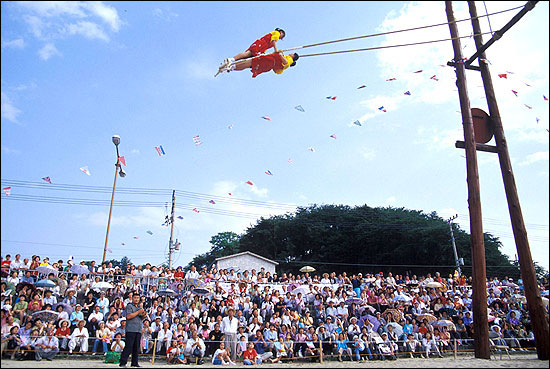
Photo by Robert at Picasa (2006-08-12-Andong)
While watching our favorite sageuk (Korean Historical Dramas) we have no doubt seen, from time to time, the young women from good families swinging on tall rope swings. The ropes can be upwards of 20 feet long and the women swing standing up. As my regular readers know by now I’m often curious about the history and culture of some of the things I see when I watch Korean movies, dramas, and even variety shows, and these huge swings have caught my eye more than once. I’ve even seen them in a Folk Village when I was in Korea, but I was too much of a chicken to try it out. (Plus I think these were scaled down ones for children to use.)
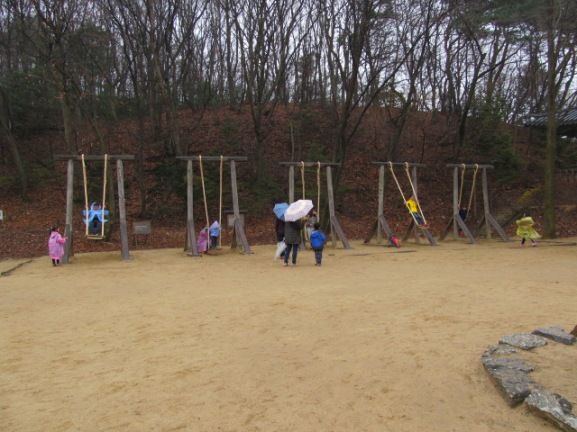
From what I can find, it seems like the Northern Tribes passed the game onto the Tang Dynasty (AD 618 – AD 907) Chinese who introduced it to the Silla Kingdom. (57 BC -AD 935). The dates and timing are somewhat vague being dependant on oral tradition until there is an 11th century written report by Gwak Won, a Sung (AD 960 – AD 1297) envoy to Goryeo. (AD 918 – AD 1392). Gwak Won describes how the Goryeo people rode rope swings during the Dano Festival which is held on the 5th day of the 5th month.
By AD 1216 we can read about Choe Chungheon, a powerful military leader, holding a huge party during the 3 day Dano Festival, during which he held swing riding contests. It seems that both men and women rode the swings and winners received silver as their prizes. It wasn’t just prizes for how high you could swing, but also for tricks like stamping your feet or ringing a bell while swinging.
It was said that having such a large gathering of men and women together led to improper behaviour, but swing riding remained popular even though in AD 1296 a ban was imposed on the pastime.
Source: http://blogimg.ohmynews.com/attach/6537/1173059949.jpg
At some point swing riding became a woman’s activity although the participants at major festivals were men. Women, kept behind walls of exclusion, took over swing riding as a supposedly healthy pastime, but it was more than that. Women often dressed in their best going out clothes and shoes, but would lift their skirts and tie a sash around their waists just as they would do for playing Neol ttwigi, the seesaw game. Both games were opportunities to show off a little and perhaps see and be seen over the high compound walls. Poets sung the praises of young women’s beauty and flushed faces after swinging, with one story even describing how a young nobleman fell in love with a girl on a swing.
Swinging remained firmly associated with the Dano Festival and since it was an exceptional festival in that it allowed women remarkable freedoms it is hardly surprising that rope swinging continued on as a popular woman’s pastime, even outside of the Festival and within their own walls.

“Danodo,” or “Scenes on Dano Day,” by Sin Yun-bok
There was a folk belief that swinging on Dano helped prevent mosquito bites and would protect women from the effects of the intense summer heat. I’m not sure that would work nowadays, but geune ttwigi is still a part of the folk heritage of Korea and can be seen at Festivals and Folk Villages.
If I see one of these giant swings on my upcoming trip I plan to gather up all my courage and see if I can swing without fear.
Have a great day everyone.
You may also enjoy ssireum, alkeggi, jegi chagi, gonggi, kai-bai-bo, ddakji, tuho, yut, spinning tops, and archery.
Please do not copy without permission and accreditation.
Recipe: Kimchi Pancake.
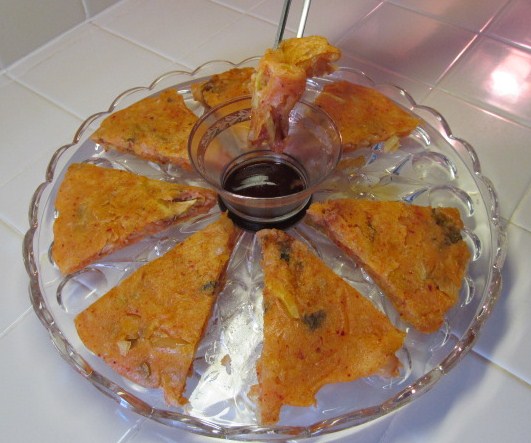
Kimchi Jeon or Korean pancakes perhaps have more in common with dishes such as Bubble and Squeak, Frittata, or even savory crepes, than with the sweet breakfast pancakes found in America. They are savory, rather than sweet, and can often be cooked as a way to use up small amounts of leftover ingredients. (There are sweet Korean pancake like dishes such as hotteok, but they are exceptions.) Korean pancakes are also similar to the above named dishes in that they can be eaten as a reasonably priced meal or snack that is relatively nutritious and easy to make. There are many Korean pancake recipes with Kimchi pancakes and perhaps Green Onion pancakes being the most known to Westerners. Seafood pancakes, along with beef, vegetable, bean, and many more are popular all over Korea.
Today I’m making a Kimchi pancake, but I had a sad looking zucchini in the refrigerator and so some of that went in today’s version along with the other ingredients. You could also use potato or other leftover vegetables as long as they are cut into small strips that will cook quickly. Don’t use too much of any of these extras, or you would be better off making a vegetable pancake.


The ingredients are fairly basic and if you don’t have rice flour you can just use all purpose flour. In a mixing bowl put in 1/4 cup all purpose flour, 1/4 cup rice flour, 1/2 tsp salt, 1/2 tsp sugar, and 1 tsp Korean red pepper flakes. Mix together. Add 3 tbs of liquid from a jar of kimchi and about 1/2 cup water to the dry ingredients and stir. At this point you want to have a fairly stiff batter as the chopped up kimchi will add extra liquid when you add it. The batter can stand for a few minutes while you continue by


chopping up 2 tbs of onion, and 1 cup of kimchi. Add to the batter along with any other vegetables or ingredients you are including. Put enough of a high heat oil in a frying pan to coat the bottom of the pan. Put on medium high heat. When the pan and oil are hot add the batter to the pan.


Cook for about 2-4 minutes or until the bottom is set. Then turn it over. This can be tricky as this a fairly solid pancake. Some people may be able to flip it but I chose to get a large flat lid and slid the pancake onto the lid cooked side down, then using the lid flipped it over back into the pan. Once back into the pan you can gently press down on the pancake, this lets some batter ooze through and that is ok because you are going to flip it at least one more time before it is cooked. Being a thick pancake you want to cook it 3-5 minutes each time you flip it so it is cooked through and crispy at the edges. You may decide to flip it one more time, or increase how long you cook it on each side. Total cooking time should be about 15-20 minutes. Place it on a plate and serve with a dipping sauce if serving as a snack. It also makes a great meal, or if cut into small pieces, a tasty side dish.


Have a great day everyone.
Alkkagi: A Korean Game.
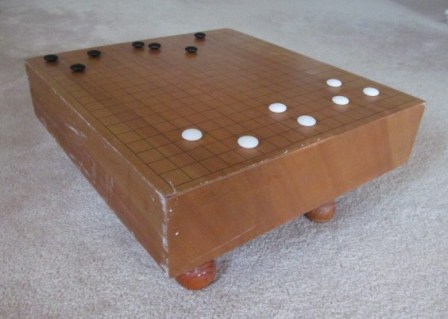
Just like a lot of people I was first introduced to this game through Korean variety shows and dramas. Alkkaggi belongs to the shove family of games along with such games as Carooms, Shuffleboard, Shove Ha’penny, and Tabletop Curling, which use one object to knock another out of play. The simplest member of this family of games is probably the bottletop game where you flick the bottletop to get it closest to the end of a table without falling over the edge.


It is usually played on a Baduk, or Go, board, although in reality it can be played on any smooth surface. I have seen players use a Janggi (Korean Chess) board or even one they have made themselves. The surface just needs to be nice and smooth and have a grid pattern on it. A Baduk board is perfect for this with a 19 x 19 grid, however, most families won’t let anyone play Alkkagi using their good boards as flicked stones can mar the surface of a $300 to $1,000 board. Many people buy cheap Baduk boards to use to play Alkkagi, or make one for themselves.
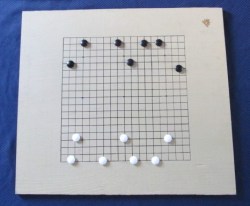
On TV shows such as Idol Star a good board is usually used because it makes for good visuals and it’s not someone’s family board. High quality Baduk boards are kept and handed down generation to generation. They are also a good height and have a good solid feel so do not move during play.
Baduk, known as Go in Japan and the West, is a game of ancient Chinese origin and was first mentioned in Korea in the second century AD. It is a strategic game that equals and perhaps surpasses the complexity of chess and was considered a necessary accomplishment for young men of the upper class. It was taught and studied, as it still is in some places today. (You can get an undergraduate degree in Baduk studies at 2 Korean universities.) However, it isn’t really what you would consider a fun game, and at some unknown point in the past Alkkagi was invented, probably by children and young men fooling around with a Baduk board and pieces when adults weren’t present. Shove type games in other countries have been dated from the 15th century onwards so Alkkagi may be very old or a recent invention, we just don’t know. It has become increasingly popular as it is seen on TV more and more.
Once you have a board you need stones or badukdol. The number can vary but usually people play with 5 or 7 on each side. The stones can be made from a variety of materials such as black slate, glass, clamshells, ceramics, or even plastic. They need to be lens or double convex, which means don’t get the Chinese ones which are flat on one side. Ceramic stones seem to be the most popular choice in Korea.
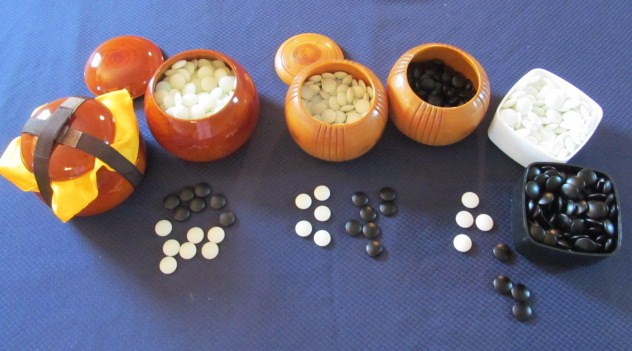
Baduk, or Go, sets usually have 181 black stones and 180 white ones. The black stones are often stronger and you want to choose thick edged stones. Thin edged stones tend to glance off more easily rather than striking true. Stones can get damaged easily so it is probably best not to use a good set of stones. If you want to make and play Alkkagi you should look around in thrift stores, garage sales etc to see if you can find a partial set of stones, or you buy a complete set and sell off smaller batches of stones to your Alkkagi playing friends. The stones can chip and break so don’t play with stones which show a lot of wear because, although unlikely, chips or stones can fly upwards and hit the other player.
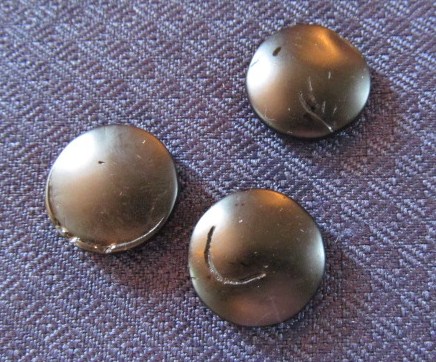 Each player places their stones onto their side of the board and then each player takes turns to flick one of their own stones so that it strikes one, or more, of their opponent’s stones and knocks it off the board. The player with the last stone on the board is the winner. The stones must be flicked and not pushed and there are many different styles of play. Niel, from the Kpop group Teen Top is an excellent player, and his flicks are very precise. A slightly different method of play can be seen when Onew from SHINee takes on Eunhyuk of Super Junior. House and local rules exist so discuss which way you’re going to play before the game begins. I love playing this game but am really not a very good player.
If you have any questions or different methods of play please comment below.
You may also be interested in Korean Variety Show Games, Part 1, Part 2, Part 3, Part 4 , omok, kai-bai-bo, gonggi, jegi chagi, yut, tuho, ddakji, spinning tops, rope swinging, neolttwigi, Juryeonggu, and ssireum.
Have a great day everyone.
Photo credits to me. Please do not copy or use without permission or accreditation.
Ramie: “Wings Of A Dragonfly.”
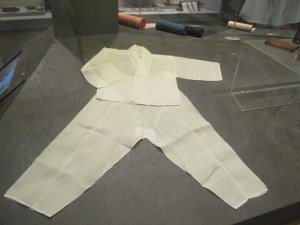
Ramie, which is known as mosi or moshi in Korea, is a bast fiber crop that is used to make cloth. That cloth is then made into a variety of cool summer weight clothes both traditional and modern. The fabric can be so light and finely woven that it has been likened to a dragonfly’s wings. In China it has been described as “light as a cicada’s wings, thin as paper, flat as a mirror, and slender as silk.” It actually gains softness and luster the more it is worn and washed. Nowadays it is often blended with other fibers such as cotton or wool and it is hard to find pure ramie clothes outside of the countries which produce it.


Ramie is a bast fiber, which means it is made from the inner bark of a plant. It comes from a plant in the nettle family and can be woven just like flax, hemp, or jute. Ramie is much sought after due to its durability and silky luster. It is resistant to bacteria, mildew and insect attack and is comfortable to wear in hot weather due to its ability to absorb sweat and wick it away from the body. Traditionally it was the fabric of choice for summer hanbok while quilted silk was prefered for winter wear.
It is difficult to produce, and expensive to buy, because the production method in Korea in particular, has remained virtually unchanged since ancient times. It is very labor intensive and requires skilled personnel to make. Some countries such as Japan do use machinery but they produce a much coarser fabric. Korean ramie, also known as Hansan ramie is considered the finest ramie available with Semoshi being the most finely textured of all. Semoshi ramie is nowadays usually only produced for special orders as only a few people retain the skills needed to make it.
Ramie has been used since prehistoric times in China, India, and Indonesia, and has been cultivated by man for over 5,000 years. It has been claimed that the ancient Egyptians used ramie for mummy cloths, however since it is hard to distinguish between flax and ramie in ancient textiles that will still need further research. Nevertheless ramie is one of the oldest fibers known to man. The oldest extant ramie clothes from Korea date to AD 1326, although no doubt they were wearing mosi cloth clothes long before then and there are references about mosi dating to the Three Kingdoms Period (57 BCE – AD 668). Most of the oldest examples of mosi clothes are housed in Buddhist temples.


The weaving of mosi in Hansan was recognized as an important part of the cultural heritage of Korea and was included on UNESCO’s World Intangible Cultural Heritage list in 2011. The knowledge and skills are mostly passed down to the younger generations by middle aged women. Even families who have made mosi for generations are not always keen to have their children learn the skill as it is tough and arduous work. Each year there are fewer people producing it.
There is a museum of mosi in Hansan and they hold a festival there every year. These photographs of ladies preparing and weaving mosi come from that festival and I found them on the VisitKorea website.

I plan on buying some ramie on my next trip to korea, whether it will be fabric or a pair of PJs or light jacket I don’t know, but it will be something to support the continuation of a traditional craft. Also since I’ll be there at the end of summer I’m sure I’ll need suitable clothes for the heat and humidity.
Have a great day everyone.
Some notes.
If you want to learn more I suggest you watch this video.
I found this lady online and am tempted to buy some mosi fabric from her as her prices seem reasonable, but I cannot attest to the quality etc, so if you buy any please let me know in the comments.
The first 2 photographs are from http://www.koreaaward.com/kor/431 and http://sanggojae.skyrock.com/3241790463-Les-hanboks.html with Lee Young Hee being one of Korea’s top designers and a huge fan of mosi fabric.
I also found that there was something called a deungdeunggeori which was a vest woven of wooden strips which was worn to prevent the layers of traditional clothing from sticking together, and increased ventilation. How smart is that.

Review: Austin Food Truck – Salsa & Kimchi.

On the way back from the Got7 concert in Dallas to my home in San Antonio I stopped by my daughter’s house in Austin. We have driven past the location of Salsa & Kimchi on E. Riverside Drive quite a few times but have never been lucky enough to catch it when open. I would suggest calling ahead ( (512) 200-3082) if you don’t live nearby, or check on the hours which are available here. But this time we were in luck, and in more than one way. It was open, the food was amazing, and we got one of the few parking spaces.

The menu had a decent selection of appetizers, tacos, and meals. We chose the potstickers to start with, which were crisp on the outside and full of tasty goodness on the inside. You can chose from a few different sauces, but honestly they were so good the sauce was just an added bonus.
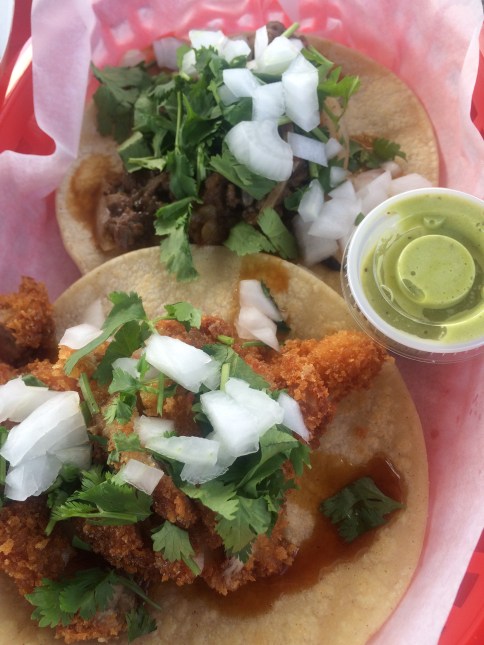
There were chicken kotsu tacos as well as beef bulgogi tacos and chicken teriyaki ones. We tried the kotsu and bulgogi ones which were delicious. They are fairly basic with minimal ingredients, but each of those ingredients added up to a really great flavor. The breading on the chicken kotsu was nice and crisp and the chicken was tender and moist with the cilantro and onions kicking up the zing factor. There was a choice of sauces and we chose an avocado one which was on a trial run. The beef bulgogi taco was also tasty and enjoyable.

The meals pretty much mirror the tacos, with the beef bulgogi one being our choice of the day. It comes with rice and homemade kimchi, which was excellent.

The prices are reasonable with our meal coming in at around $18 with more than enough food for the two of us. The wait time was perhaps a little long, but that was a small price to pay for such a delicious meal. Next time we will probably call ahead for takeout as, although covered, the seating area was hot under the Texas sun. The owner was pleasant and helpful and I understand he will adapt and stray from the menu for his regular customers. All in all I would recommend eating at Salsa & Kimchi and I know I’ll be going back next time I’m in Austin.
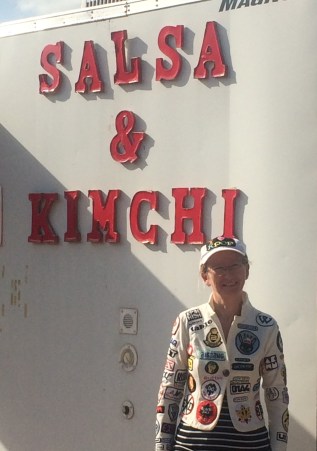
On a side note it is less than 5 minutes off Highway I35 so if he’s open it’s a great place for a meal en route. If you try the food here let me know in the comments what you had and what you thought. Thanks.
Have a great day everyone.
Got7: Fly in the USA Concert Review.
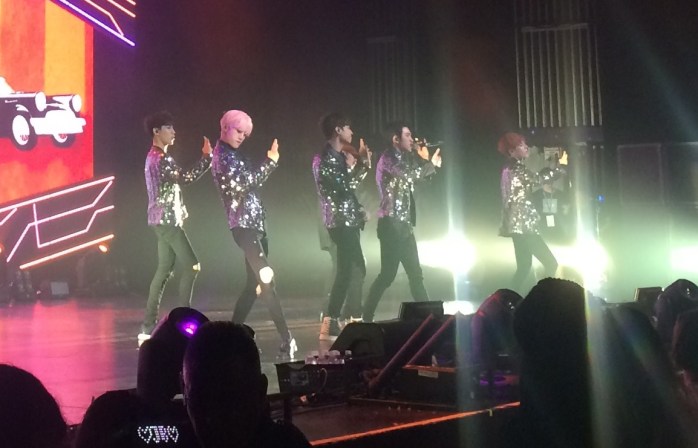
On Friday July 1st the Kpop group Got7 held their first concert in the US and their first stop was Dallas, Texas. They had previously held a Fan Meeting here and so it was not their first trip to Dallas, although this time more fans were at the airport to greet them, some even trying to follow them to their hotel. The venue was the Verizon Theatre in Grand Prairie which by now, after hosting over a dozen Kpop concerts, should have better methods in place for dealing with the enthusiastic fans who are a part and parcel of Kpop. The early entry in particular was very poorly handled. Once inside past the absolute chaos of actually getting inside I met some really nice and helpful staff. Although the parking is expensive the traffic flow pattern has improved over time and getting in and out is a little better.


The auditorium itself is spacious with the seats set decently apart and with just enough of a rise between rows to allow most people a good view of the stage. There were large screens set up to allow those at the back close up views of the action. The stage itself had minimal sets, unlike JYP’s other group 2pm who had a fairly impressive stage when they performed at this same venue in Nov. of 2014. Most of the audience, however, probably wouldn’t have noticed sets anyway as they were there to see their idols.


Got7 is a 7 member boy band, although due to an illness Youngjae was unable to perform. This did lead to some gaps and very slight confusion during the performance but the other group members did a remarkable job covering for their absent friend. Junior in particular seemed to feel the absence of Youngjae and seemed a little nervous too. It seemed to take him a little while to get into the swing of things; that is not to say that he was not performing well, just that he seemed stiff and uncomfortable, like he was not having fun. His smile showed up as the evening progressed and by the end of the evening he looked happy and relaxed and was doing the most fanservice for the crowd. He was particularly cute at the very end when they stood together for a group shot and he hurried to the side of the stage where he had earlier seen a fan with a light up Youngjae sign. He asked to borrow the sign and it was held up in place of Youngjae for the final group photo of the concert. He was so sweet.


JB also missed Youngjae particularly as they were scheduled to perform the duet 1:31 together. JB sang alone and did an amazing job of holding everyone’s attention even though he was alone on stage. The crowd supported him wholeheartedly. JB was also super cute during a brief chat session when he was asked about Youngjae not being there on stage with them. He said he was sad, especially because he had a duet with him. JB really did look sad, in a forlorn lost puppy kind of way. The famous JB smile was a little slow in lighting up the stage during the first part of the show, but as he relaxed that captivating smile did appear and he stopped looking like an anxious dad. I’m sure as the leader he had many concerns and I was glad when he began to look like he was really enjoying himself. JB also spoke to the audience with a few words in English, although most times he relied on the translator or one of the members who speak English.


Jackson was his usual over the top self and if he was nervous at any point he didn’t show it. He was very caring of his fans, at one point recommending we all drink organic green tea, eat our vegetables and take care of ourselves so that we can be together with Got7 for a very long time. He threw himself into some of the dances with vigor and was impressive to watch. He joked around from time to time and even though the auditorium was freezing he was the first to take his jacket off and we got ample chances to see his toned arms.


Mark was cute and smiled a lot and it didn’t take long for him to relax enough to grin and give the side eye to other members on the few minor mistakes they made as they adjusted their choreography to fill in for Youngjae. He was at ease during the chat sessions since he speaks English, and joked around with Jackson and BamBam and the audience. His acrobatic dance moves were on point as was to be expected.


It is hard to describe BamBam’s performance except to say that not only did he sing and dance and have fun, he also seemed to be the energy drink that kept everyone ‘up’ and excited. He smiled at his other members as much as he did to the audience, he patted the small of a back or a shoulder when passing during dance moves and generally was encouraging and supportive. He was cute and adorable and all those attributes we love him for. At one point towards the very end BamBam threw a towel out into the audience near me. It was so funny in that he threw it so hard, for it to only land about 3 rows from the stage. Aw BamBam we love you.


The MVP for the concert for me had to be Yugyeom. Maybe because he’s the youngest he didn’t have the concerns of his hyungs, or maybe it is just his nature, but he was having a blast and it showed. He put his all into the choreography and it was a joy to watch him dance. His smile was contagious and it even popped out during some of the more serious songs until he corralled it back under control. He tried really hard to speak to the audience in English and you could tell that everyone of those words was from the heart. He was adorable, and young, and full of the joy of life. It was hard to take your eyes off him. Well done Yugyeom, you did well and your hyungs should be proud of you.


As a group Got7 performed and put on a first rate concert, they were a little stiff at the beginning but gradually each member began to relax and have fun. They all came together with Home Run and after that everything was completely amazing. They interacted well with the audience, who loved every minute of the concert screaming their hearts out and unceasingly waving their light sticks. Got7 provided their fans with an amazing act of fanservice by appearing and walking through the aisles of the theatre thereby giving so many fans the opportunity to see them up close. Some fans even got to touch their hands. That was a wonderful thing for them to do. Three member passed within 4 feet of me which was exciting.


I was fortunate to be one of those who got to have the photo op with the group after the concert and this was the highlight in multiple ways.

I was able to speak a few words to JB and thank him for the concert and also when interest was shown in my jacket I exchanged a few words with Jackson. So eye to eye contact and a minimal conversation with two members that should be enough for any fan, right. But it got better when I heard a voice saying, “look at her shirt….um jacket. She has all of them. Where is Got7? Where is Got7?” It was BamBam who had noticed my jacket and wanted to know where the Got7 patch was on my jacket. Eye contact as I turned to show him where the patch was. He also saw my parasol and asked me if it was raining and I replied it was for the sun. He seemed like he wanted to say something else but my time was up and I was ushered out. What an end to the evening. And BamBam, if you ever read this, Got7 is between BigBang and Shinee, so you are in good company.

If you were at the concert and would like to share some of your thoughts and experiences please feel free to do so in the comments.
Have a great day everyone.
Reviewing a Korean Movie.
I watch a lot of foreign films, particularly those from South Korea, and I have noticed that when I recommend foreign movies to my friends some question my choices. They ask what was so funny, or sad, or they even completely miss aspects of the plot. This is somewhat understandable with the distraction of trying to read subtitles while also trying to watch the flow of the action, but I have occasionally noticed this with British movies where subtitles don’t come into play. That’s when I had a small epiphany and realized that with certain movies, particularly big blockbuster action type movies or those that fall within our cultural norms, we either don’t need to know background references or we already know them through our upbringing and regional media coverage etc. We watch and just know what is happening or why a character acts, or reacts, in a certain way. We don’t need someone to explain it to us, we just know.
This doesn’t always hold true for movies from outside our sphere of cultural knowledge, it’s not instinctive and we have to work harder to understand the nuances of the film. Some knowledge can be gained by learning a bit of history and the traditions of the country, or by watching media reports, or living there etc. but in some senses someone not from that culture will never view a movie in the same way as the person from that culture. So does that mean we shouldn’t watch foreign films or that we won’t like them or understand them? No, of course not, it is just something to be aware of, particularly when discussing said movies.
As an example I’ll use the Korean movie, The Host, from 2006 as this was one of the first Korean movies I watched. The title in Korean is Gwoemul, the literal translation of which is ‘monster’, which in some ways makes more sense to me than ‘host’, but this may well be that the Director was deliberating trying to say something to English speakers. If you watch the movie you can see why both titles may each be appropriate in their own way. To me the word ‘monster’ as the title can mean both the actual monster, or the actions of the Korean and US governments, military, and bureaucracies, which is why I prefer it.
The movie draws inspiration from two things that actually happened. A Korean mortician working for the United States military did indeed dump an unknown (said to be large) amount of Formaldehyde down a drain into the Han River. This happened in 2,000 and was in the Korean news resulting in many being upset with the US military. (For those who don’t know, the US retains a large number of troops in South Korea, and has agreements and rights within the purview of treaties signed by both governments. This sometimes leads to uneasiness on the part of everyday citizens, although most Koreans acknowledge the presence of said troops as a deterrent to North Korean aggression, and everyone I met in Korea loved Americans. Also note the movie was filmed in 2006.)
The second was the discovery of some deformed fish in the Han River, with S shaped spines. I cannot find anything that tries to link the two together, but they were put together to form the kernel from which the movie sprang.
The Han River plays an integral part in the movie, just like it does in the life of those who live in Seoul. It is big, it is really big, and it slices through the middle of Seoul. Many bridges cross the river, and huge numbers of people cross by cars, buses, and trains. It is also where many go to relax and play, with there being many public parks and green spaces that line the river. (There is a statue of the monster in one such park and every now and then it moves its mouth and roars. When I was there Korean parents were letting their kids stand in the mouth to take photos, and then laughing as the kids freaked out when it moved.) In some ways the Han River is the heart of Seoul and an attack on it would be a giant blow to many Koreans. Is that why the movie was set in and around the river, and particularly in the sewers and under the bridges? Maybe, I don’t know, but when the government tries to make the Han River and its riverbanks an exclusion zone and want to use chemical warfare against the monster the people begin to rebel.
It is hard to classify the movie as it can be seen as a horror movie, a monster or ‘creature feature’, a melodrama, a satire, or a family movie in the sense that it revolves around a family and their interactions with the monster and government bureaucracy surrounding the appearance of the monster. In some ways it can also be seen as a kidnapping movie, as the family probably wouldn’t have the same feelings about the monster if it hadn’t taken their youngest member. This is a film that revolves around ordinary people stepping outside who and what they are, a fairly dysfunctional family in reality, to come together to get their family member back. No superheroes or action heroes here, just everyday people.
Eating together has a significance and importance in Korean life that is hard to explain to others, and so the scenes of eating have meaning beyond what we might see. The belief in ghosts and the providing food for the dead at certain times of the year are also outside most of our cultural experiences, so the nuances of the feast where the granddaughter appears have meanings that non Koreans probably won’t understand. So what might appear to be slow or down times to us in the movie probably have cultural meanings that are lost to us.
The movie incorporates humor in sudden and quick bursts that in some ways shock us and then make us refocus on the drama, just as in real life something can make us laugh even when we are sad. It also showcases some underlying digs at practices that still can occur in Korea, such as bribery, unwarranted sueing, uninterested and unlistening police, bureaucratic inefficiency, and the two boys need to loot for food. (This last one, Seori, was practised by the kidnapped girl’s father when he was a boy and so leads to perhaps why he adopts the younger boy at the end of the movie.)
There are more things I see each time I watch the movie as I learn and understand more about Korean culture, but does that mean you won’t enjoy the movie if you don’t know much about Korea? No, The Host stands as a good movie no matter where you’re from, it just might have more meaning the more you know.
It was first shown at the Cannes Film Festival in 2006 to much acclaim. It was one of the best reviewed films of 2007, scoring 92% on Rotten Tomatoes. It set a box office record in Korea and won Best Film at the Asian Film Awards and Blue Dragon Film Awards. It was ranked as one of the Top films of 2007 by Metacritic.
You can watch it on Netflix where it only has two stars which I think is undeserved. I’ve tried not to give away too much of the plot so if you haven’t seen it already give it a watch, and let me know what you think in the comments.
Have a great day everyone.
Dakjjim: Simmered, or Braised, Chicken and Vegetables.
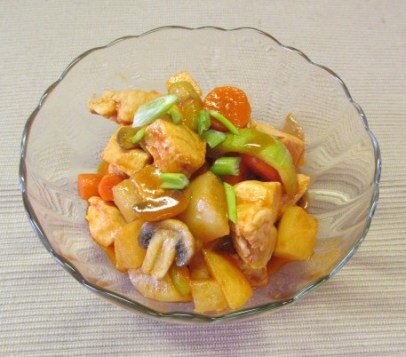
Dakjjim, also sometimes Dak Chim, is a spicy chicken and vegetable dish from Korea. As with many traditional dishes there are many regional and family recipe variations. My recipe was influenced by recipes from the Institute of Traditional Korean Food and the Korean Table Cookbook, since I don’t have a Korean eomeoni (mother) to pass along a family recipe. In many ways this is a great recipe for using up vegetables that you have on hand, which is why my recipe still keeps changing and evolving. I also don’t always measure each ingredient, but go by if it looks right. Most Korean recipes would use dark meat from a chicken such as thighs and legs, or even a whole chicken, as dark meat is more flavorful. I found a great deal on chicken breasts so that’s what I used.


I used 2 large chicken breasts. First rinse in cold water and then pat dry with a paper towel or clean cloth. Trim or cut off any icky bits like excess fat or cartilage. If you are using chicken legs or thighs buy them already deboned, or cut the meat off the bone yourself.


The vegetables used to go with the chicken can vary, but I think it is nice to have a variety of colors, tastes, and textures. You can see I chose white and red onion, carrots, a small piece of daikon radish, a couple of potatoes, a small zucchini, some button mushrooms and a spring onion for garnish. Peel the root vegetables and cut into small chunks.


Place the potatoes to one side as they will take the longest to cook, then the carrots and daikon radish which don’t need quite so long to cook. Wash/wipe the mushrooms, and then peel and scrape the seeds out of the zucchini. Cut mushrooms in half and zucchini in slices, place to one side. Peel and roughly chop the onion. I used a total of half an onion, but I like onions.


Place your cut up chicken chunks into a lightly oiled frying pan. Make sure your pan and oil are hot before you place the chicken in. You want to ‘brown’ the chicken on all sides to seal in the flavor. This may take 3 to 5 minutes or more depending on temperature and size of chicken chunks.


In another frying pan heat some olive or vegetable oil and add the potatoes. Cook for 3 minutes or so, stirring every now and again. Add the carrots and daikon radish and continue cooking, then add the onions. The mushrooms and zucchini are last as they need the least amount of precooking.


In 3/4 of a cup of water add 1 teaspoon dark sesame oil, 1 or 2 tablespoons of hot pepper paste depending on your heat tolerance, (I used 2), and 2 tablespoons of the soy base sauce from the last post. Mix well. If you don’t have any sauce pre made, use 2tbs soy sauce, 1 tsp sugar, 1 tsp minced garlic, 1 tsp sesame oil and 1 tsp minced ginger.


Add the chicken chunks and vegetables together, add liquid and stir together. Cover with a lid; you can see I had trouble finding one large enough and ended up using a metal pizza tray. Cook on low to medium for 15 to 20 minutes, stirring once or twice. You don’t want the liquid to boil away, although some recipes take the alternative view and want you to cook the last few minutes on high to boil away the liquid giving the chicken and vegetables a glaze rather than a stew like quality. I like the stew type more because the liquid can soak into my rice making it more flavorful. Both ways are good so experiment a little to see which you prefer. After all you may be the one creating your family recipe to pass on to your family members.

You can now add the spring onions, and if you feel really fancy you can fry an egg and cut into strips as an added garnish.


I hope you enjoy this recipe as it is one of my favorites. Let me know how it turns out.


Have a great day everyone.
You may also like Korean Tea, An Easy Way To Make Japgok Bap, Rice…Feeding Half The World Everyday, and My Favorite Place to Stay in Seoul.
Please do not copy without permission and accreditation. Photo credits to Debora Marzec.
 KPOP Jacket Lady
