KPOP Jacket Lady
KDrama and KPOP Concert Reviews, Travel Tips, Korean Recipes and more
Hwarang: The Flower Boys of Silla.

Please note that although the article is a little old now, the information on the Hwarang is still valid.
Those of us who follow Korean Dramas have probably already heard news of the upcoming sageuk, Hwarang, the Beginning which is already in production. The cast list looks amazing with Park Seo Joon and Park Hyung Sik playing the two male leads and Go Ara as the female lead. The cast also includes flower boy idols such as Kim Tae Hyung and Choi Minho.

The drama is not set to air until the second half of this year, perhaps even as late as Dec. 2016. So while we wait I decided to find out a little more about the historical background of the Hwarang.
The drama is set in the time of King Jin Heung (ruled 540-576 CE) the 24th monarch of Silla during the Three Kingdoms period, who came to the throne when he was only 7, although he did not actually rule until coming of age at 15. King Jin Heung was a very important figure of the time and did much to assist the eventual unification of Korea. He ruled for almost 37 years, although before he came of age his mother ruled as Regent.
One never knows with historical dramas whether there will be any real truth, or if the writers will just make up the whole story, but I found out that the Hwarang did in fact exist. According to documents from the 12th century CE they were groups of young men from good families who were educated in martial as well as the finer arts. They had to learn to dance, to sing songs, and play music, as well as be proficient in archery, swordsmanship, horsemanship and the like. They were often taught by Buddhist monks although researchers have suggested that aspects of Shamanism might account for the focus on singing and dancing. They were noted for taking trips to the mountains and out into the countryside. And they were also known for being attractive, for wearing beautiful clothes, and even for wearing makeup. It seems to me that their aim was to be the perfect man, attractive, well educated, and able to fight well for his country and King.
The Hwarang followed 5 basic rules; they must be loyal to their King, they must honor their parents, they must be loyal and trustworthy friends, they must be brave in battle, and they should not take a life unless necessary. They stayed with their own group which was led by one of their own, and lived and learned together, forming groups who had strong ties to each other. Although not totally a military group the Hwarangs were used as troops in battle, however, as they grew older they left the Hwarang and moved on with their lives and became soldiers, advisors, and court ministers. The Hwarang were older boys and young men training to be the best they could be for the betterment of their country, all while looking beautiful and wearing makeup.
A Chinese official of the time wrote, “They choose fair sons from noble families and deck them out with cosmetics and fine clothes and call them Hwarang. The people all revere and serve them.” The middle image below is of an emissary to the Chinese court from Silla. You can definitely see he is the best looking of the three.

I’m somewhat surprised that more dramas haven’t been written about the Hwarang, since they present a perfect excuse to fill the screen with attractive young men. They do appear in other Sageuk such as The Great Queen Seon Deok, and maybe they were present in other dramas and I just didn’t realize who or what they were.
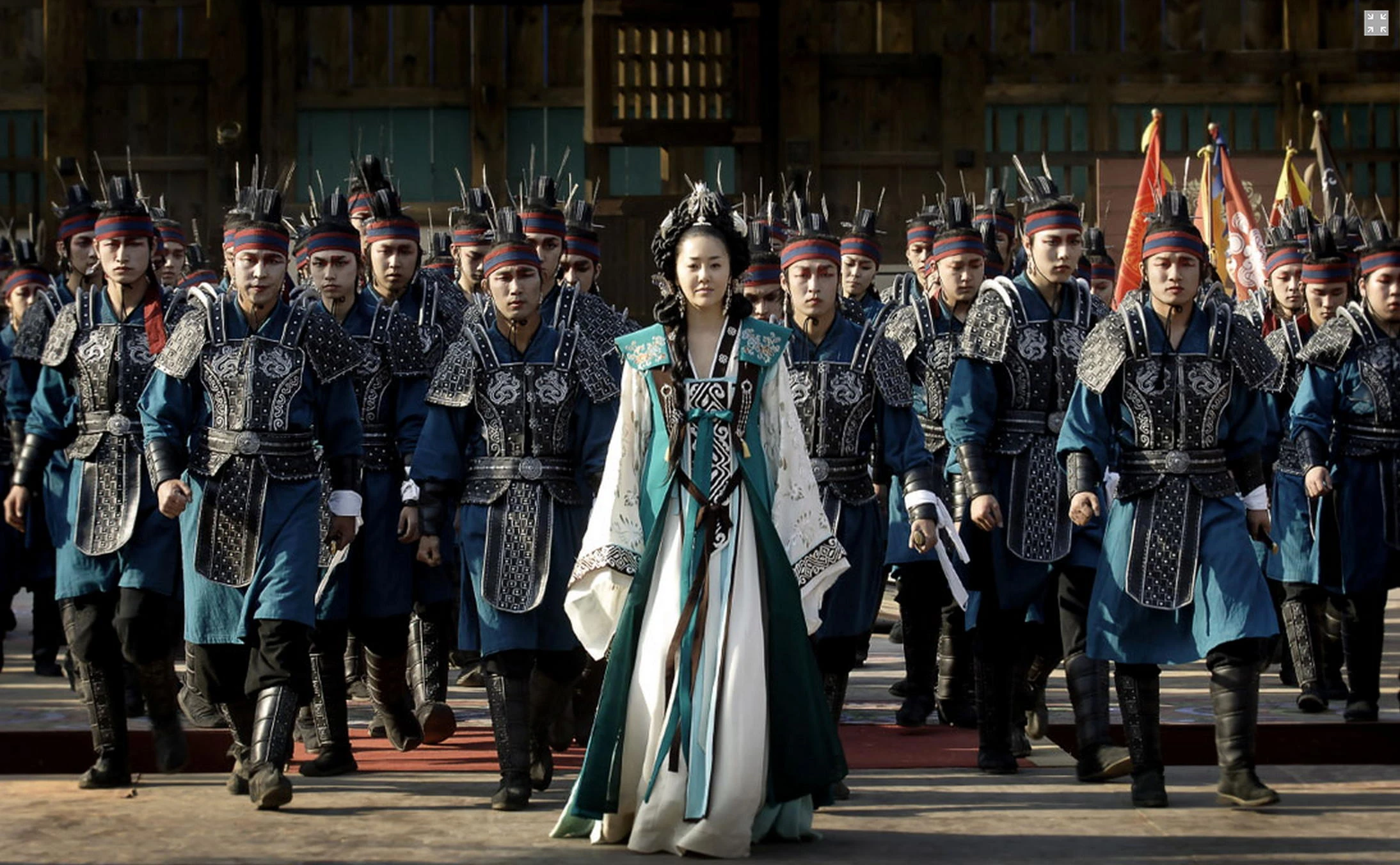
I’ll be eagerly waiting for the drama, and hope to see that they follow some of the actual attributes of the historical Hwarang, or Flower Boys of Silla.
Have a great day everyone.
Please do not copy or use without permission and accreditation.
Photo credits to original owners. First photo to http://www.phxhwarangdo.com
You may also like Goblin, Guardian, or God, Is it the Kdrama Actor? Archery in Korea, Juryeonggu: A 14 sided die from Silla, and Horseback Archery, A Traditional Korean Sport.

Edit, Hwarang: The Beginning shows them playing various sports and games, you can check out Juryeonggu, and Jokgu here.
Note. If anyone knows of the Hwarang appearing in any other K Dramas please let me know in the comments below. Also different translations have Hwarang, as Flowering Youth, Flower Knights etc. and there is still much debate among researchers as to their actual role in Silla society. There has been a push in recent years by some people to change their role to suit what they want them to be, not what they were. Notably some Martial Arts groups claim them as the inventors of a certain style of fighting, which may, or may not, be true. Just like the legends of Robin Hood have changed over time so some of the stories of the Hwarang may have been changed.
Gonggi: Korean Jacks, or Fivestones.
 Gonggi is an old, perhap ancient, Korean version of the game of Fivestones or Jacks. You can see by the photo above that there are many versions of this game. While we in the West tend to associate it with children it historically was also played by adults, as it still is in many parts of the world. Modern gonggitdol, or stones, are made out of brightly colored plastic and are slightly weighted. The modern set I bought came with two extra gonggitdol. Historically five small pebbles would have been used, or even the knucklebones of sheep.


There is no evidence to suggest when people first started playing this family of games, but there are ancient Greek and Roman records of the game, and even statues and paintings that show girls in the process of playing. While I am sure the game originated with five stones or pebbles, people in ancient Greece and Rome started using the knucklebones of sheep as their prefered stones. In the ancient Middle East 5 small cubes of metal or wood were used. Later even the Vikings played games with knucklebones.


Unfortunately I can’t find any evidence of people in ancient Korea or China playing Gonggi/Fivestones, but I would not be surprised to hear that the game has been played for thousands of years in those countries. I do know that knucklebones are still used in parts of China to play Fivestones as a Chinese lady challenged me to a game one time. She was really good and easily beat me.
Most of us who follow K dramas or K variety shows will have seen Gonggi played from time to time and seen how challenging it can be for those who have not played before.
The basic goals and method of play are similar, but different cultures have different rules of play. As far as I can tell Gonggi is very similar to how I played as a child except I used 10 jacks and a ball. Using a ball is easier in some ways, but also allows for different variations.
Usually you sit on the ground in a circle with the playing area in the middle. To start the game you have to decide who goes first. The first player gently tosses the 5 gonggitdol on the ground and then picks up one. That one is tossed into the air and one of the other gonggitdol must be plucked from the ground and held before catching the one tossed into the air. You are not allowed to move any of the other gonggitdol while doing this so you must make sure your first toss at the beginning doesn’t bunch them all too close together. If you fail or move one you lose your turn and play passes to the next player. If you succeed then you may continue picking the gonggitdol up one by one.
In the next stage of the game after you have tossed out the gonggitdol you must pick up 2 at the same time.
The next stage would be three and then the remaining one.
And then you would try to pick up all four.
Lastly you place all five in the palm of your hand, toss them up and try to catch them on the back of your hand. You only score those that you catch on the back of your hand. The first person to a predetermined score, wins. Sometimes the score is called years, so you might find someone might say to play to 5 years or 20 years etc.
As I’ve mentioned before there’s lots of slight rule variations so check first with whoever you’re playing with. Even as an adult this is a fun game to play and I find the Korean playing gonggitdol or stones are nice to play with and easier than the big knucklebones I’ve tried using. I bought mine from Amazon.com but I’m sure there are many places online to get them.
Edited (Sept.2016) to add that I found this really nice set on Jeju island, made by 2 ‘halmoni’ with whom we had a charades type conversation to show that I knew how to play, and that I had grown up playing the English version.
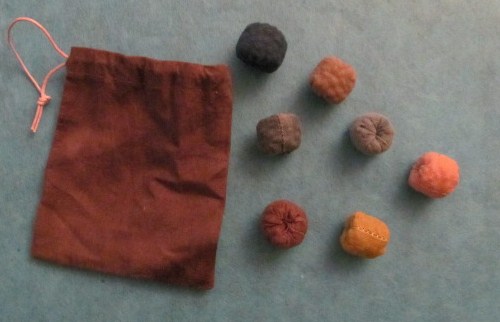
If you have any further information on the game please feel free to share it in the comments.
You also may be interested in kai-bai-bo, jegi chagi, ssireum, alkkegi, yut, tuho, and ddakji.
Have a great day everyone.
Sweet Stuff: A Trip to Tous Les Jour Bakery.
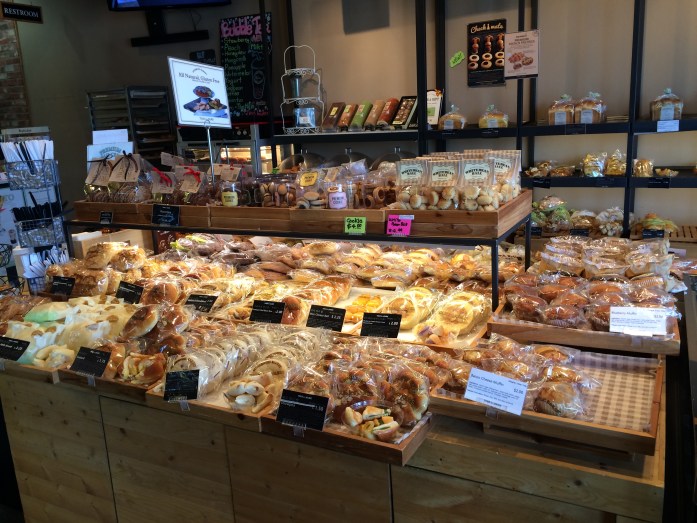
On a recent trip to Austin, TX. my daughter and I made a beeline to one of our favorite places to stock up on goodies for the 3 day weekend ahead of us. It was the French-Asian bakery Tous Les Jour. (I don’t have a Tous Les Jour Bakery in San Antonio so my closest is in Austin.) They do have bakeries all over the US, usually in larger cities or where there is a decent sized Korean population. It is called a French-Asian bakery because the basic idea of a French bakery was used and updated with a Korean flavor. The pastries are filled with things like sweet potato, bean paste, or my newest favorite sweet pea paste. There’s breads and pastries, and cakes, and sweet rice donuts, and so many other delicious goodies too numerous to list.


When you first walk into the store you look for the stack of wooden trays and tongs, using these you stroll around and make your selections. This can take a while, both because of the interesting choices, but also because you can taste small samples of many of them.I always find it hard to narrow down my choices to what is a reasonable amount for one person to eat. Then again I’m not always known for being reasonable!

After having made our choices we went to the counter to pay and to order our drinks and cake. We were visiting the bakery mainly to pick up some yummy treats, but of course we couldn’t leave without sitting down and enjoying a slice or two of their amazing cakes. The cakes not only look beautiful, but taste delicious too. We ordered a slice of a green tea cake and a chocolate cake. Wow, I really can’t explain how good the green tea cake tasted, it was somehow cool and refreshing which is not something I thought I’d ever say about cake.


There’s a wide selection of drinks available from coffee and tea, to fruit based drinks, smoothies, bubble tea, and seasonally, shaved ice. Good as these are, it is the baked goods and cakes that bring me back time and again. Maybe it is the tastes of Korea that remind me of my visit last year, or the whole European pastry shop thing that I miss, but whatever the reason, I’ll be back.

If you get a chance to go to a Tous Les Jour bakery I do heartily recommend you do so, even if you have to hunt one down. They are often fairly nondescript on the outside, but there’s so many good things on the inside. In general the cakes and pastries aren’t quite as sweet as their US counterparts, and the bakery only uses the best ingredients. There are also savory selections and sandwiches available. But it is the sweet treats that usually bring me back. There’s bread choices too, but I haven’t tried those yet. Maybe next visit.

Have a great day everyone.
Happy 300th Running Man, part 2.

Both parts 1 and 2 focus on the seven members of Running Man against 300 of something. In the first part we see them having to choose an old episode and answer a question about that episode. Then it is them having to write 3,000 Korean syllables over a 300 meter track, followed by trying to beat their VJs in eating 300 dishes. The last mission of part 1 was 7 v 300 boxes of ramen. They had to gather as many boxes as possible and put them on their truck before Bangtan Boys could do the same by putting the boxes on their own truck. Like most Running Man guests BTS were enthusiastic and energetic, with a couple of the members really entering into the spirit of the game.
There were some funny moments during part 1 and I liked the idea of celebrating their 300th show by having the overall 7 v 300 theme, but some of the missions were definitely more entertaining than others. Thank goodness BTS showed up.
As I’ve said before Running man is still my favorite K variety show, but I worry about the future. Some games can become boring when repeated, but some games are classic for a reason, so I was pleased to see that Ddakji would appear in part 2. Ddakji has been a part of multiple episodes and was even the featured game in episode 197. In that episode, broadcast in May 2014, 7 Universities from around the country were pitted against each other in a Ddakji Tournament. The prizes were scholarships and of course school pride was on the line. Each Running Man member could choose 2 students and each school could have 300 students as supporters/cheering squad. The latter part of that episode was quite tense and exciting and I believe did a lot to encourage more people to play Ddakji.
Part 2 did indeed start off with Ddakji, unfortunately and unexpectedly, Yoo jae Suk performed poorly and only beat 3 opponents. Kim Jong Kook competed in Arm Wrestling and did well, beating 52 people. The other team members all took their turns with varied success and eventually lost by 2 people. They managed to beat 298 people which is pretty impressive.
The highlight of the episode for me was the very short pillow fight segment which may go down as one of Running man’s classic moments. Kim Jong Kook v Lee Kwang Soo. in particular were both funny and entertaining, as was HaHa.
The end of the episode was a cross between a hidden treasure type race, although this time they were looking for their personal set of scales, and a name tag race. But the name tag part was 2 unknown people ripping name tags off the players in the dark. This game, although it had potential, was a little weak and the episode didn’t end on a high note. The losers of the race had to walk back down the mountain which is a way did hark back to some of the punishments handed out in the early years, which was cool.
If you aren’t a fan or haven’t watched Running Man may I suggest you watch a couple of episodes and see what you think. And if you are a fan what’s your favorite episode, or game, or even guest? Write in the comments and let me know.
Have a great day everyone.
How to make Ddakji.

Ddakji, also spelled ttakji, is a traditional Korean game that has seen a revival due to its appearance on K variety shows such as Running Man.
Ddakji is part of a family of games that include Milk Caps, Menko, Tazos, and POGs. In all these games the idea is to flip one item over using another. It must flip only once, so it would flip from side A to side B. It doesn’t count if it flips twice, or multiple times, and lands on A, it only counts if it lands on the other side to what it started on.
Ddakji are fairly easy to make and in theory the game is easy to play. But in reality in order to make the Ddakji flip you need to hit the one on the ground in just the right place with the right amount of power.
To make Ddakji you need 2 squares of paper. You can use printer paper, cardstock, origami paper, cardboard etc. I used construction paper for the examples here. Ddakji can be of various sizes, but I find the 3×3 inch Ddakji I end up with when starting with a 12×9 inch piece of construction paper works well for kids and those with smaller hands. If you want to make larger ones a 12×12 inch square would make a 4×4 inch finished Ddakji.


Construction paper is a rectangle so first you have to make a square. Take the bottom right corner and fold it so that the bottom edge lies against the left side of the paper. Press down on the fold to get a nice crease. Cut the remnant piece of paper off the top and you are left with a square. You will need 2 squares to make 1 Ddakji.


Fold each square into thirds. You might have to use a ruler, or you can just eyeball it, but the more even all your folds are the stronger and neater your final Ddakji will be. Once it is folded into 3, fold the bottom right corner over so the bottom edge lies neatly against the left edge. Make a similar fold at the top like in the photo. The paper clips are just to help show what it should look like at this stage.


Place one on top of the other as shown in the photo. Then fold the left one in.


Do the same with the others. The last one is a little tricky.


Tuck the last one under, and then push all of it together a little to make it tight. Now you’re ready to make at least one more and then a game of Ddakji can begin. It is a nice idea to make a few in different colors so a few people can play. You can also put a sticker, or draw something, on the other side. Be inventive and have fun.

Let me know if you play. Have a great day everyone.
You may also like Korean Variety Show Games, part1, ssireum, tuho, jegi chagi, alkkagi, gonggi, and yut. Check them out.
Photo credits to me. Please do not copy or use without permission and accreditation.
Korean Innovations: The Internet Cafe.
Just a quick note for today.
Although you will find differing opinions it seems to me that The Electronic Cafe in Seoul, S. Korea was in fact the first ever internet cafe. It was just across from Hongik University and had 2 computers connected by dial up (telephone service). The year was 1988 and Ahn Sang Su and Keum Nuri the inventors/proprietors.
Another early contender was the chain of SF Coffeehouse Network in San Francisco, which used coin operated computers! The first to use the name Cybercafe was in London in 1994 and it had full internet access.
S. Korea has often taken ideas and then turned them into something better, but in this case it looks like they came up with the idea first. Internet cafes, that provide the computers, have recently seen a decline in many parts of the world, but for a while they were extremely popular. I can remember traveling to London about 15 years ago and the first thing we did was find an internet cafe to let everyone at home know we had arrived safely. Nowadays all we have to do is find a hot spot or take our laptop into almost any cafe, bar, or restaurant. In Asia, however, the internet cafe has morphed into the PC Bang, an internet cafe used for multiplayer games. These have become very popular as the price of owning your own computer of sufficient quality to play these top ranked multiplayer games has skyrocketed. With access to the PC Bang many top Game players in the world come from S. Korea.
So the internet cafe, first begun in S.Korea, has grown and adapted and is still going strong, even though the name and purpose have changed
Seasoned Bean Sprouts.
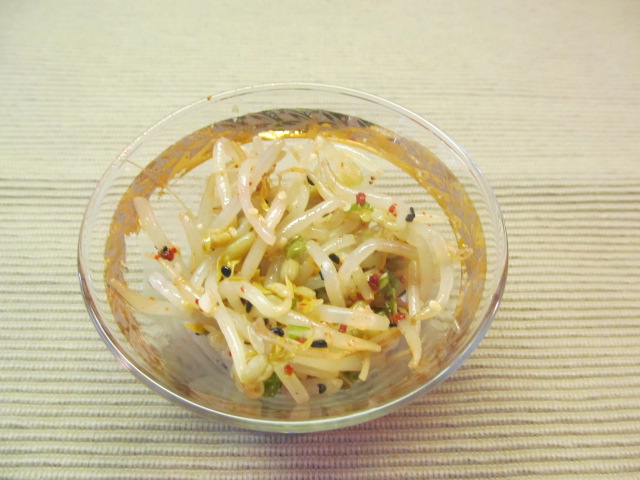
Before I talk about the recipe I used I want to make sure that everyone knows the dangers of eating raw or undercooked beans. Beans contain something called Lectin which in some foods can be harmful. Different foods and even different beans contain different amounts, with Red Kidney beans containing the most. Green beans contain a different kind of Lectin which only causes problems for some people. You can get rid of the Lectin by soaking, and/or cooking the beans. You can also use canned beans in recipes instead of having to soak dried beans before cooking. Bean Sprouts are not as bad as beans, but they have been tied to e-coli and salmonella outbreaks, so if a recipe says to soak or to cook something it is often for a reason and it is best to follow the recipe. Should that put you off eating an otherwise healthy food? That is a question only you can answer.
In Korea this recipe would be made with soybean sprouts which are usually available at your local Korean grocery shop. I substituted mung bean sprouts as they were available just at my local grocery store. The main difference in preparation is that soybean sprouts should be cooked/steamed for about 10 minutes while mung bean sprouts need about 3 to 4 minutes. When soybean sprouts are used the recipe is called Kong Namul and is a very popular side dish. There are quite a few slight variations of this seasoned vegetable side dish.
Seasoned Bean Sprouts.
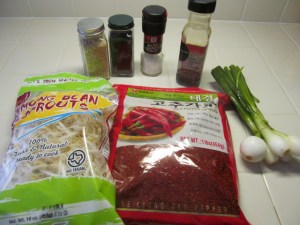
Take a pound of mung bean sprouts and rinse them under cold water. Pick out any dead or icky bits. Finely cut up 4 tablespoons of green onions or scallions, put to one side. Crush 1 tablespoon of sesame seeds, preferably roasted sesame seeds.


In a medium saucepan put 1/2 cup of water and 1/2 teaspoon of sea salt on to boil. Once that is boiling place sprouts into pan and cover with lid, reducing heat to low. You are aiming to steam the sprouts instead of actually boiling them. Steam for 3 to 4 minutes. Drain any excess water and place sprouts in a bowl. Immediately add 1/2 teaspoon salt, the chopped up spring onions, 1 teaspoon Korean red pepper flakes, and one tablespoon dark sesame oil. You want to mix everything together while the sprouts are warm as that helps the flavors develop.


Mix it all together and allow to cool before putting in a container and putting in the refrigerator. It will last 2 days in the refrigerator.


Now that you have the basic recipe down you can start changing it up a bit, add some minced garlic, a bit of red pepper paste, or even minced ginger if you’d like, because all you’re really doing is making your vegetables taste good. So your personal taste matters. I made a second batch with some extras in it and you can see the color change from the first photo. I did add some garlic and a bit of red pepper paste and that really made the flavors pop.


Enjoy. Have a great day.
Happy 300th Running Man.

Running Man is a Korean variety show that is extremely popular not only in Korea, but around the globe. It is particularly popular in China and the rest of Asia, but with the advent of sites like YouTube, Drama Fever, and Viki, Running Man has fans around the world. To get full versions of the early years you might have to use a service like Drama Fever. China even has its own version, Hurry Up, Brother, which closely follows the idea of the original.
I started watching Running Man six years ago and have watched every episode since then. They just celebrated their 300th show / 6 year anniversary a few days ago. Many congratulations to everyone involved. It is quite an achievement for a Korean variety show to last so long. I believe only Infinite Challenge and One Night Two Days have lasted longer. Running Man has not only filmed episodes in Korea, but also in Australia, China, Thailand, Indonesia, Vietnam, Taiwan, and the UAE.
I began watching to follow Yoo Jae-Suk and Kim Jong Kook who I had enjoyed in the variety show Family Outing. The first episode was set in Times Square, a huge mega mall located in Yeongdeung po-gu, Seoul. (When we visited Seoul we stayed in an apartment just across from the main entrance to the mall and visited regularly to pick up snacks, or grab something we needed from E Mart.)
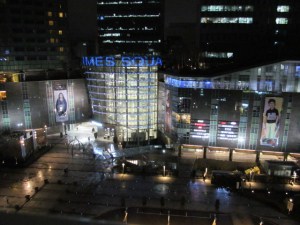 The first episode introduced the members we know now; plus Song Joong Ki, who was a regular on the show for the first 40 or so episodes, Lee Hyori, who was there to counterpoint Yoo Jae Suk and help MC, (they had had a bickering brother/sister type relationship on Family Outing), and a guest Hwang Jung Eum. The first episode had some funny moments, but it was a little chaotic at times as even the members didn’t seem sure of what to do and what roles they should play. The fake laugh track irritated me and I had to get used to the instant repeat of funny moments, something we don’t tend to see on US programs. But the overall concept seemed fun and it had great potential. The shy Lee Kwang Soo in the minivan near the beginning is nothing like the character he is now. Song Joong Ki was so cute and his smile captivating. HaHa had some funny moments and Gary was, well Gary. The clothes hanger race was funny and original and the chicken fight had its funny moments. I liked the idea of using such an original location although I don’t think they used it to its full potential.
Song Ji Hyo was not a member at the very beginning but was a guest for episodes 2-5 before becoming a member in episode six. I can’t imagine the show without her now and really admire her for being the only female with six male members week after week. Lizzy from the group After School was a member for about 10 episodes before she disappeared with no reason given.
The early episodes continued to be a bit uneven, but the cast members began to work out their roles and there were always funny moments, some that made me laugh out loud which is not something I do very often. The highlights of many of these early episodes were the locations, the guests, and the name tag battles. Some of the guests were big names in Kpop, acting, and sports. Jung Young Hwa of CN Blue and Nichkhun of 2PM have appeared on multiple episodes and always been great, even challenging Kim Jong Kook on a physical level as well doing well in the challenges. Kim Woo Bin and Kim Kwang Kye, both actors have appeared multiple times and sports greats like Ryu Hyun Jin (baseball), Cho Sung Hoon (MMA), and Park Ji Sung (soccer) have also appeared on the show.
The show moved away from some of the earlier themes like being locked in a building, but has kept most of the popular things. The name tag game has become iconic and many guests are disappointed if they don’t get to play it during their appearance. Producers and staff have changed over time and the equipment and video quality seem to have improved over the years. I’m not sure I like the direction the latest producer is taking, but I’m willing to give him some time to settle into the position. Some of the recent games have been a bit confusing and not really all that much fun, and I worry some of the cast are becoming almost caricatures of themselves. It must be very tiring for the cast to continue acting out their personas every week when they are not really like that in real life. Still with all the ups and downs Running Man is still my favorite K-variety show.
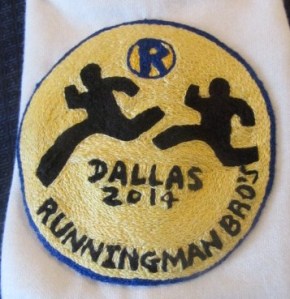
I met, very briefly, both Kim Jong Kook and HaHa at the Running Bros concert in Dallas and was impressed at how they really seemed to be nice people. I hope one day to meet the rest of the cast members, and my dream would be for a Running Man episode to be filmed here in Texas. Think of all the fun things they could do here, from cowboys and rodeos, to sports, NASA, beaches, theme parks, and great food like barbecue, steak, tacos etc.
The second part of the 300th celebration episode doesn’t air for me until next week so part 2 will be posted shortly, and I’ll include instructions on how to make your own ttakji/ddakji.

Until then, let’s keep on Running. Have a great day.
Open Sesame.
I think we’ve all heard that saying before without even giving a second thought as to why the thieves used it as the magic phrase to open the door to their lair. Well it turns out that the sesame seed that we use in cooking pops out of its pod when ripe, which is similar to the thieves wanting their door to pop open. The pod kinda explodes little seeds all over the place, which actually makes it hard to harvest, so the farmer has to harvest it right before that happens.And the sesame seed is what I want to talk about today.

The sesame seed is an important part of the cuisine of many cultures, and the seeds and the oil are frequently used in Korean cooking. The sesame seed plant was probably domesticated in India more than 4,000 years ago. It is a tough plant that can survive and grow in harsh conditions and sometimes has the nickname of ‘survivor crop’ because it will grow where other plants cannot. From India the use of the plant as a food crop gradually spread outward, to Asia to the east, to the Middle East to the west, and through sea trade southwest to Africa. Nowadays it is commercially produced in many countries around the world as it is a billion dollar industry. India and China grow the most, although China also is one of the biggest importers, along with Japan. It turns out that China exports food grade sesame seeds but imports oil quality ones.

Sesame seeds have a nutty flavor and a subtle crunch; they are also incredibly healthy for you. Sesame seeds are a good source of copper, calcium, phosphorus, magnesium, iron, zinc, B1, selenium, and more. The seeds can come in a variety of colors, like white, yellow, black, grey, and red. The color of the seeds can also be changed dependent on whether they are roasted or not. Koreans tend to like to extra roast the seeds so if you buy Japanese or unroasted sesame seeds you might want to roast them at home for your Korean recipes. The seeds can go rancid if stored too long so don’t use any that have a funky smell. Koreans also use sesame oil and sesame paste in their recipes. If you can’t find the sesame paste easily you can substitute tahini.
It is a good idea to have both roasted sesame seeds and sesame oil in your pantry if you plan on doing much Korean cooking, they are staples in a lot of recipes. I only found white and black in my local grocery store, but plan to look for some of the other colors. The black seeds taste stronger and have a more complex flavor than the white.
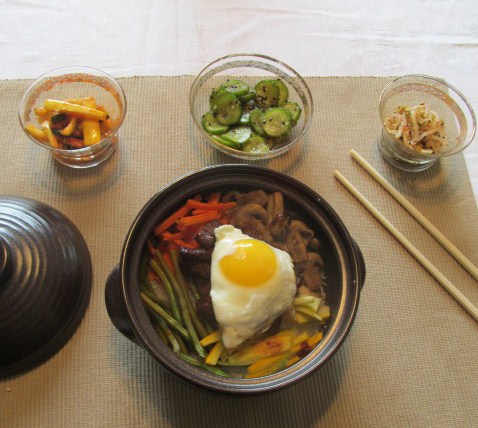
Cucumbers Seasoned with Sesame Seeds. Oi Bokkum Namul.

A fairly quick and simple side dish that uses sesame seeds and sesame oil. You’ll need to find the little baby cucumbers, not pickling cucumbers because their skin is too thick. I was lucky and found these in my local grocery store, otherwise I would have used an English or hothouse cucumber.


Wash, and dry 3 or 4 baby cucumbers with a paper towel, then top and tail them ,and then cut into slices. Put them in a bowl and sprinkle with salt. I use a mix of sea salt and pink Himalayan salt. I put a plate on top to cover them and slightly press them down to allow excess water to drain from them.


After about 10 minutes gently squeeze out the excess water that has formed. Heat a frying or saute pan on medium and add 1 tablespoon of dark sesame oil. Add the cucumbers and stir fry for 2 or 3 minutes. Put them in a bowl and add 1 tablespoon of sesame seeds. I used a mix of black and white sesame seeds.


Add some ground black pepper to taste, and check if it needs a little more salt. Put it into a storage container and when cool move to refrigerator. It will only be good for 2 or 3 days in the refrigerator so you can try adding it to a green salad or even in sandwiches to use it up.


Enjoy. It was part of my dinner tonight.
Korean Innovations: The Heated Greenhouse.
I love watching Korean dramas, being awed by the costumes and sets.Sometimes I see something in a Sageuk and wonder if it was real, or just something that was just added to the script. This recently occurred when I saw a heated greenhouse full of flowers while watching a period drama set in the early Joseon Dynasty. A heated greenhouse seemed to me to be something that was developed much later in time so I decided to investigate.
I knew the Ancient Romans had passive methods of keeping plants alive during the winter, by growing plants in carts so they could be rolled out into the sunshine during the day and then rolled back under cover at night time. They gave the name Specularium to a house where they grew plants out of season. Pliny, a famous Roman author, even mentioned that they used oiled cloth or thin sheets of a mineral that was opaque to help protect plants from the weather.
There are also accounts of 13th. century Italians having special houses to grow plants and to protect them from the weather. But both these were passive methods, meaning that you were basically trying to gather heat and light for the plants during the day and to protect the plants from the cold at night.
Korea has a cold winter climate and a passive greenhouse would hardly be able to keep plants healthy and growing in the harsh Korean winters. I began looking on the internet and found a couple of references to Korean greenhouses that had the ability to have the temperature increased or maintained inside the greenhouse. The first was from The Annals of the Joseon Dynasty from 1438 AD where an ondol (underfloor heating system) was used. (Early forms of ondol for Korean house floors may date back as far back as the early centuries BCE.) The second was from Sanga Yorok, a cookbook and growing guide from about 1459 AD. I looked for a translation of this cookbook, because it sounded really cool and would have some amazing recipes and clues to what life was really like back then, but was unsuccessful. I did, however, find a few lines written in Korean and let google translate them into English. The gist of it is that the greenhouse had 3 walls of oiled paper with one wall on the south side also having a lattice and an extra layer of wax paper. The fourth wall was not described, but I assume it was a solid wall. There was some form of matting that could be rolled down at night, or to protect the paper walls from cold winds. The ondol heating system could heat the floor which was covered with a layer of dirt. The dirt floor was sprinkled with water to ensure the right humidity for the plants to grow. Pretty sophisticated system for the time.
The author of Sanga Yorok was one of the Royal Family doctors and I’m sure any heated greenhouses of the time were only built for royalty or the very wealthy. Still, I find it interesting to note that as far as I can tell these heated Korean greenhouse were the first for which we have written proof, and that the Sageuk writers knew about them as well.
See anything in a Sageuk you’re curious about? Contact me and I’ll see what I can find out.
 KPOP Jacket Lady